Friday, November 17, 2017

An Update on the Railyard Lawsuit

Attorney Bill Goodell speaks at the
January 2017 Y-49 public meeting 
The lawsuit asking that the Union Pacific Railroad take action on its abandoned railyard in downtown Lafayette received a lot of attention in our community and the press in 2016. However, for most of 2017 little has been discussed or reported on the railyard lawsuit.  It is therefore time to review the lawsuit and its present status.


In February of 2016, The legal team for the lawsuit plaintiffs - the Salvation Army, et al. - filed a petition with the court against defendants including - the Union Pacific Railroad, and the Southern Pacific Motor Company. The lawsuit was reported in all of the Lafayette local newspapers throughout 2016 (see the list of articles at the end of this post). In press releases in 2016, the plaintiff's attorney, William Goodell, summarized the case. Goodell's February 2016 news release read in-part:

Despite an Environmental Impact Statement, two prior lawsuits, piecemeal testing, and decades of environmental regulatory agency “oversight”, no meaningful action has been ordered, much less taken, to require a comprehensive assessment of the environmental impact.
Soil and shallow groundwater testing on file at the LDEQ confirms the presence of a toxic stew of “Superfund” hazardous substances perilously perched atop the Chicot Aquifer; yet, available LDEQ records reveal no testing or cleanup in the Chicot has ever been ordered or performed.
The documented contamination at the site constitutes an illegal, imminent, and substantial endangerment to the health and safety of Plaintiffs and the entire Lafayette community.
A comprehensive, site-wide assessment of the former rail yard is necessary to design a meaningful cleanup of the former rail yard and adjacent areas, to eliminate the threat it poses to the Chicot Aquifer, to prevent further contaminant migration, and to protect the entire Lafayette community.
The suit challenges Defendants to meet with Plaintiffs’ attorneys and experts and LDEQ to promptly:
  1. Accept responsibility for this environmental damage;
  2. Develop and adopt a mutually agreeable comprehensive assessment plan that will identify and characterize all contaminants throughout the entire site;
  3. Define the horizontal and vertical extent of that contamination both on and off site; and
  4. Adopt a timeline to properly and expeditiously clean up Defendants’ toxic legacy to the Lafayette community.  ...
The lawsuit alleges a failure to warn the people of Lafayette of the dangers that the rail yard contamination presents, and that:
“In the past and to this very day, Defendants actively concealed and intentionally failed to disclose evidence of the ... contamination despite clear knowledge of it and its dangers to Plaintiffs and the Lafayette community.”

On December 14, 2016, plaintiff's attorney William Goodell issued a press release further detailing what is known about contamination at the site, and calling for our political leaders in Lafayette government and our Louisiana state agencies to "embrace" their constitutional "responsibilities as public trustees and do the right thing." In a further press release on December 20, 2016, Goodell warned against continuing to pursue I-49 Connector land acquisition and construction until the Union Pacific Railroad (UPR) has responded to demands to survey and clean up their contamination. He warned specifically that


  • I-49 Connector construction will increase damage to the aquifer from UPR contamination and make public entities involved partially liable for the aquifer damage
  • I-49 Connector construction will make cleanup of UPR aquifer contamination more difficult, more expensive, and more time consuming—if not impossible
  • UPR rail yard cleanup as a part of the I-49 Connector construction project will make taxpayers foot the bill for UPR responsibility


I have noted public misunderstanding and some individuals stating wrong "facts" concerning the railyard lawsuit. As I have discussed this case with others in the community, or read their social media commentary, I have been surprised to hear otherwise well-informed people saying, for example, that I, Mike Waldon, sued the railroad (I did not!), that the Sierra Club sued the railroad (they did not!), and that the plaintiffs sued the city government (they did not!). Others have implied to me that this  lawsuit is backed up by little evidence of any serious risk coming from the old railyard - nothing could be further from the truth!


Since December, I am unaware of any media coverage of the railyard lawsuit. So, you may ask "what is the current status of the suit? For almost one year the legal fight has been over whether the proceedings should move forward in a federal or a state court. The plaintiffs initially filed in state court, but the defendants argued that it should be moved to federal court. This question has finally been answered, and a state court will hear the case. With that question resolved, we should begin seeing substantive legal progress in the coming months.

Related Lafayette News Articles


Daily Advertiser February 1, 2016, Lawsuit filed over contamination in I-49 corridor


The Independent December 20, 2016, Contamination lawsuit moving forward

Saturday, July 8, 2017

Drinking Water Supply in Lafayette: Early history to the mid-1950's

The Beginning
Some anthropologists and archaeologists believe that humans lived continuously in the region that we now call the Teche-Vermilion basin for at least five thousand years, and perhaps much longer (Cheramie, 2013). On the banks of Bayou Vermilion near Paul Breaux Middle School (originally Paul Breaux High School) there was a freshwater spring called Chargois Springs (Figure 1) which supported a large Native American settlement. Griffin (1959) reports that for a long time, students of Paul Breaux High School "turned in to the principal after every good rain arrowheads and pieces of pottery that were on the school grounds."

Findings strongly support the hypothesis that native Americans lived at the Chargois Springs in relatively large numbers for a very long time (Cheramie, 2013). The Chargois Spring was probably a Native American meeting place where trade of all kinds took place. The availability of clear cool fresh water, in combination with its location on a ridge between the Atchafalaya Basin to the east and the prairies to the west would have made this an ideal habitation site. Evidence of long-term habitation suggests that the Chargois Springs was fed by a stable free-flowing artesian aquifer, the Chicot Aquifer, for centuries if not millennia prior to the coming of European colonists.

The Chargois Springs were the location of many picnics reported in lafayette newspapers before 1900. Soon after the 1927 flood, Chargois Spring ceased to flow, and while some attributed this to river sediment sealing the spring, it is more likely that dredging of the Vermilion River next to the spring cut through the clay confining layer which maintained pressure within the Chicot Aquifer which fed the spring. The resulting loss of pressure would have caused the formerly free-flowing spring to stop flowing.  Griffin reports that in the 1950's the place still bore the name Chargois Springs and older Lafayette residents fondly recalled bathing there when the water still flowed.

Figure 1. Photo from Griffin (1959): "A Picnic at Chargois Springs about 1898. The back row: George Bailey, (2) Anita Hohorst (Mrs. J. Franklin Mouton), (3) J. Alfred Mouton, (4) Stella Raney, (5) Neveu, (6 ) Alix Judice (Mrs. J. Alfred Mouton) with guitar, (7) Ned Mouton (brother of Vavaseur), (8) Louise Judice (sister of Alix Judice), (9) Dr. Gabriel Salles (Josette Salles' brother), (10) Frank Moss.  Sitting: (1) Florian Cornay, (2) ?, (3) Albert Judice (brother of Louise and Alix Judice), (4) Martha Mouton (back), (5) Marie Revillion (front Mrs. Marsh), (6) Felix Salles (front), (7) Sidney Mouton (back), (8) Emily Moss (Mrs. George deBlanc), (9) Johnny LeBesque (end). "Souvnir offert a Stella Trahan (the daughter of Dr. Trahan) par un ami sincere et devoue, Sidney Mouton," is written on the back of this photograph."
Today, the combined impacts of pumping for irrigation and municipal uses, excavation, and dredging have reduced pressure within the aquifer from a state of positive pressure and free flow, to a negative pressure now measured as static well water elevation roughly 50 feet below surface in Lafayette (see, for example,  Figure 6, Waldon, 2017a). Chargois Spring now serves as a reminder of how failure to consider the consequences of our actions can lead to unanticipated destruction of what could have been a sustainable resource for ourselves and our children.
Figure 2. Ad from the Lafayette
Advertiser, Dec. 8, 1900.

Throughout most of the 19th century, Lafayette residents had to rely on either rain fed cisterns (Figure 2), surface water, local springs, or numerous individual wells to provide for their domestic water needs. Shallow domestic wells for drinking water were associated with risks to health because of contamination from the surface, and citizens preferred drinking water from cisterns (Lafayette Advertiser, 1897). Deep wells were considered a low health risk because water was purified by "natural filtration" through soil and sand. However, deep well water was considered less desirable in taste and clarity when compared to rainwater. The development of municipal treatment that filtered and clarified deep well water contributed to the demand by citizens for city water utilities providing drinking water and municipal fire protection.

1897-1954
The city-owned public water and electricity utility was created in 1897 (LUS, 1953, 1954), and both municipal electricity and water services have been continuously provided to the residents of Lafayette by the public utility since that time. The original plant had eight artesian wells placed ten feet apart with depths ranging from 150 to 200 feet (Lafayette Gazette, 1898). The City Engineer, Mr. R. R. Zell (1898), reported to the City Council that the original municipal artesian wells could produce over a million gallons of "good water" per day which exceeded the steam powered water pump capacity. However, by the fall of 1899 only two wells were used by the utility and these two wells had "dried up." The City Council then approved boring a new replacement artesian well to a depth of 200 feet.

Despite the establishment of a municipal water system, by 1900 many of the 3000 Lafayette City residents continued to rely on domestic wells and rainwater cisterns to meet their water needs (page 59, Griffin, 1959). Additionally, deep commercial wells are known to have existed at the railyard and the refinery prior to construction of the municipal water system (Lafayette Gazette, 1895). Based on this, it is reasonable to assert that there are numerous now abandoned domestic and commercial water wells from that early era which were never plugged in a manner that would be required today. These abandoned wells are a conduit that may today be allowing surface contaminants to be drawn into our drinking water aquifer.

Municipal water systems were not only important for providing domestic and commercial water service, but also significantly contributed to the city's fire protection. In 1902, 1919, and 1928, citizens voted for bond issues which extended the water system and also funded improvements in other municipal services (Griffin, 1959). The North Water Plant building (Municipal Filtration Plant) was constructed in 1929 (Figure 3) with funding from the 1928 bond issue and property taxes. Today that original building is a part of the Lafayette Utilities System (LUS) North Water Treatment Plant facility.
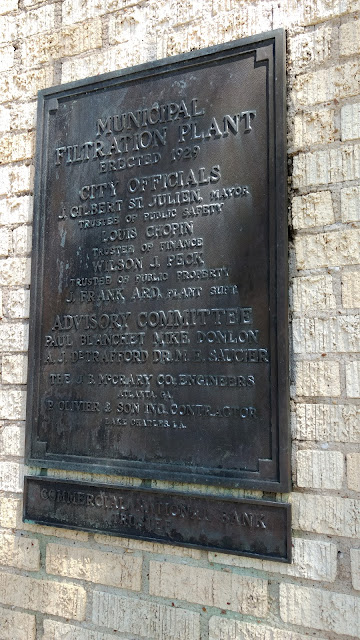
Municipal Filtration Plant, Erected 1929, City Officials J. Gilbert St. Julien, Mayor, Trustees of Public Safety, Louis Chopin, ...
Figure 3. Plaque on the North Water Treatment Plant showing that 
it was initially erected in 1929. 

In 1949, the City of Lafayette Board of Trustees adopted a bond resolution for $7,000,000 which funded improvements and extensions to the waterworks plant and the water distribution system, as well as other utility improvement for the electric power and the sewer systems. By October 1952, numerous improvements and extensions were completed or underway (LUS, 1953). The extent of the water system owned and operated by the Utilities System at that time is shown in Figure 4. This map shows the entire water distribution system, including extensions constructed under the bond improvement program.  About half of the water distribution network shown in Figure 4 was newly constructed under the 1949 bond improvement program.

Construction of a major plant expansion was started in September, 1952 . This plant extension added two open-type filters, one new Accelator clarifier (Figure 7) in an existing settling basin, and a new aerator. This expansion also included an extension of the main building to the north for chemical storage and feeding for lime (Figures 5 and 6). Water plant treatment capacity was expanded by 1.5 mgd (million gallons per day) which increased the total treatment capacity of the water plant to 4.5 mgd.

Figure 4. The Lafayette water distribution system in 1952 is mapped in this graphic (LUS, 1953). The water treatment plant is highlighted in red. A 500,000 gallon elevated water tank is to the right of the treatment plant in this map. Fire hydrants are mapped as black dots, 12" mains are mapped as heavier black lines, 4-10" mains are the finer black lines.

In the early 1950s, water supply for the City of Lafayette was obtained from a system of wells averaging 245 feet in depth in the Upper Sand of the Chicot Aquifer. Part of the wells were located on  the filtration plant grounds and part on a nearby separate lot at the intersection of Simcoe and Chestnut Streets (LUS, 1953, 1954). Table 1 shows the location of the five water wells operating in 1952. Wells #1 and #2 were abandoned during that year because of unspecified "difficulties," and a new well was planned at the Simcoe & Chestnut site.

Unit #
Location
1
Simcoe & Chestnut
2
Simcoe & Chestnut
3
Filtration Plant Grounds
4
Filtration Plant Grounds
5
Filtration Plant Grounds
Table 1. LUS water wells in 1952 (LUS, 1953).

The LUS Comprehensive Engineer's Reports (CERs) tell us that the system's water wells drew water from a sand and gravel strata which requires extensive screening at the base of the wells (LUS, 1953, 1954). Operation and maintenance of the wells and pumping equipment was reported to always be somewhat of a problem. It appears that wells loosing productive capacity as the wells aged continued. It was reported that the wells were treated with Calgon and HTH (calcium hypochlorite) on an experimental basis resulting in some increase of production. In 1954, wells were constructed fairly close together on the System's properties. However, it was planned that the next new wells might be built on separate property, some 2,000 feet from the treatment plant, where it was expected to have less influence from any of the other wells (this new site may have referred to the site of today's Clark Field and Hebert Golf Course). Water treatment plant expansion in the early 1950s (Figures 5-7) increased capacity from 3.0 million gallons per day (mgd) to 4.5 mgd (LUS, 1954). Difficulties with wells in the Chicot Aquifer Upper Sand, a desire to have higher production, and the recognized need to further separate the well intakes from surface contamination may all have been considerations that led to most of our present day wells being drilled deeper into the Chicot Aquifer Lower Sand.


Figure 5. This photo from the 1953 CER shows an expansion of the water treatment 
plant building which expanded the original 1929 plant building.


Figure 6. The expanded water filtration plant (LUS, 1954).


Figure 7. Clarifier constructed as a part of plant expansion (LUS, 1954).

Summary and Conclusions
The Chicot Aquifer has provided a plentiful source of water for millennia, and, if protected, will continue to provide for the water needs of future generations. The Lafayette municipal water system began in the late 1800's. By 1953, Lafayette's municipal water system had expanded to serve 9,247 households and businesses and supplied 825 million gallons of water annually (LUS, 1954). This is 2.26 million gallons per day, or about 240 gallons per customer per day. At that time all of this water was being pumped from the upper sand of the Chicot Aquifer from wells located near the water treatment plant on Buchanan Street at Mudd Avenue.

When the utility began operation at the end of the 19th century, the Chicot Aquifer was a freely flowing artesian water source. This pressure within the aquifer had been protective of the quality of the groundwater from surface contamination because any connections with the surface through springs (Chargois Springs for example), sand inclusions, cracks, abandoned wells, or flow through the confining clay layer itself would flow from the aquifer toward the surface. However, pressure in the Chicot Aquifer has been falling for a century (Borrok, 2016; Borrok and Broussard, 2016).

By 1954 the artesian spring no longer flowed, and pressure had diminished from positive to negative in the Chicot Aquifer. Any hydraulic connection of the aquifer to surface water became a conduit for flow into the aquifer transporting whatever contaminants were present at the surface into our underground drinking water source. Groundwater moves very slowly, often a few feet to a few hundred feet per year. Still, this reversal of groundwater flow direction which took place many decades ago sets the stage for destruction.  Recent observations of man made contaminates in Lafayette's drinking water wells (Waldon, 2017a, 2017b) serves to heighten citizens' concerns, and have led to a call for action (Waldon, 2017c).


REFERENCES

Borrok, David M. (2016) At Your Service: Keeping the Chicot Sustainable, Interview on KPLC TV News, Lake Charles, Published on Dec 21, 2016.

Borrok, David M., and Whitney P. Broussard III (2016) Long-term geochemical evaluation of the coastal Chicot aquifer system,Louisiana, USA. Journal of Hydrology 533:320-331.

Cheramie, David (2013) The Legacy of Native Acadiana. Acadiana Profile, August-September 2013.

Griffin, Harry Lewis (1959) The Attakapas Country: A History of Lafayette Parish, Louisiana. Pelican Publishing Company, Gretna, Louisiana,

Lafayette Advertiser (1897) Typhoid Fever and Water Supply. December 18, 1897, page 2.

Lafayette Advertiser (1999) New well. October 20, page 1

Lafayette Gazette (1895) Mr. Zell's visit. November 2, 1895, page 3.

Lafayette Gazette (1898) Water and Light: A model plant nearly completed - Everything works without a hitch. March 5, 1898, page 1.

Lafayette Gazette (1899) New artesian well. October 21, page 1.

LUS (1953) Comprehensive Engineering Report as of October 31, 1952. Prepared by R.W. Beck and Associates for the City of Lafayette Louisiana Utilities System.

LUS (1954) Comprehensive Engineering Report as of October 31, 1953. Prepared by R.W. Beck and Associates for the City of Lafayette Louisiana Utilities System.

Waldon, Michael G. (2017a) More Evidence of Chicot Aquifer Contamination: USGS Monitoring. ConnectorComments.org

Waldon, Michael G. (2017b) Contamination of our Chicot Aquifer.  What do we know? How do we know? What should be done? ConnectorComments.org

Waldon, Michael G. (2017c) Citizens seek action to protect our health, property, and drinking water supply. ConnectorComments.org

Zell, R.R. (1898) Report to the City Council on completion of the Waterworks and Electric Light Plant. Lafayette Gazette, April 16, 1898, page 1.


Thursday, June 29, 2017

LFT Airport Update


(Why is there a $200 million problem looming at LFT? Be sure to read to the end to find out.)

A presentation on the current status of the Lafayette Airport (LFT) and planned airport renovations was an agenda item for the June 20, 2017 Lafayette City/Parish Council meeting. Presenters were Valerie Garrett, Chairwoman of the Lafayette Airport Commission, and Steven Picou, LFT Executive Director. Paul Guilbeau, Vice-Chairman of the Lafayette Airport Commission was also in attendance. Their summary update document provided by the Council Clerk is available here.


View the 12 minute video of the airport update by clicking here or view it in the frame at the bottom of this post.

STEVEN L. PICOU
LFT Executive Director

Steven Picou's update summarized these points:

  • LFT has hired their Program Management/Construction Management (PMCM) firm
  • 5000 citizens gave public input that contributed to the selection of the Journey renovation design
  • The Disadvantaged Business Enterprise (DBE)program at LFT is a priority
  • Part 139 inspection had zero discrepancies
  • LFT is prepared for tropical storms and hurricanes
  • Past year's cargo handling of 24.6 million pounds is up from the prior year 
  • The cargo handling facility is opening, UPS and Fed-X are moving in

The I-49 Connector plan requires moving a runway at LFT -

Dr. Michael Waldon asked during public comment if the runway displacement required by the I-49 Connector project would result in any changes to the renovations. He also cited his minimum safety requirement calculation that shows that the displacement would need to be 860 feet rather than the 350 feet stated in the I-49 FEIS. This calculation was published last year in the ConnectorComments.org post titled Airport angles and increased risk. Mr. Picou replied that he had not seen the published recalculation of the displacement. Further, he said that new FAA regulations would require an additional 1000 feet of runway if it is reconstructed. Mr. Picou stated that the airport "has hired a firm to look at that information." Currently the airport is constructing an EMAS system (engineered materials arrestor system) at the end of this runway. He also said that Dr. Kam Movassaghi had led a student design project that might eliminate or reduce the required displacement, but DOTD has not reported any study of such options.

District 9 Councilman Theriot asked whose responsibility would it be if the runway had to be displaced. Mr. Picou answered that FAA has taken the stance that it is not their responsibility, and it is not the airport's responsibility. He went on to say that in his opinion "It is Federal Highways responsibility." FAA takes the stance, he said, that millions of their dollars have already been spent on the airport, and it is not their responsibility.

The bombshell of the evening occurred when Councilman Theriot followed up by asking what the cost would be. Mr. Picou replied that a rough order-of-magnitude estimate is $200 million dollars. In part, this cost is so high because the FAA would no longer allow the use of an EMAS at this end of the runway, which results in an added runway length requirement of 1000 feet.

While there may be intergovernmental discussion of which tax dollars will fund this $200 million (or more), in the every case it is taxpayers who will pay and citizens who will suffer added flooding from the loss of flood storage currently provided to Lafayette and St. Martin Parish residents by the Cypress Island Swamp.


LPC-AirpotUpdate-2017-06-20 from Mike Waldon on Vimeo.


Tuesday, June 27, 2017

Citizens comment on the environment, energy, ethics, and other topics - June 20, 2017, Lafayette City/Parish Council


The Lafayette Consolidated Government Council meetings are open to the public, and citizens may make comments within the scope of each agenda item. Furthermore, 5 minute comments on any subject are taken monthly at the second monthly meeting. This month, June 2017, eight citizens brought issues before the Council (click for video of all comments) during the June open comment period.

The following is a list of speakers and the subject of their comments. Links in the list will take you directly to the start of each citizen's comment.
  1. Simon Mahan - good government, and making it easier for citizens to participate and comment
  2. Michael Waldon - the Chicot Aquifer, contamination of Lafayette's drinking water source, and contamination at Lafayette's abandoned UPRR railyard, and citizen recommendations letter
  3.  Kim Goodell - Civic duty, Watermark Alliance, Chicot Aquifer protection including wellhead protection, an update on the ongoing lawsuit concerning railyard contamination, and citizen recommendation letter
  4. Andrew Hebert - the conflict of interest inherent in our city/parish council districts
  5. Kasandra Ford - Renewable energy, Chicot Aquifer protection, drinking water testing, railyard contamination, risks from I-49 Connector plan, and Indivisible Acadiana
  6. Matthew Isaac - Protection of the Chicot Aquifer, drinking water testing, railyard contamination, and citizen recommendations
  7. Dennis Sullivan - Opposition to the I-49 Connector plan, the LRX
  8. Lillian Espinosa-Gala - Electric vehicle charging stations in Lafayette, noise and fumes from the I-49 Connector, the LRX, and hurricane evacuation from Port Fourchon to Houston
Next month open comments should be scheduled during the July 25, 2017 meeting, and we hope that some of the issues brought forward this month will be addressed by Council members at that time. Immediately following that July 25 meeting, the Council will initiate their budget review process which should lead to significant citizen comment.

Video of the entire 3 hour meeting which was recorded by the Acadiana Open Channel Community Media may be viewed at http://www.ustream.tv/recorded/104993499
A pdf file of the meeting agenda is available here.

Monday, June 19, 2017

Make your ideas known through public comment to our Lafayette Parish Council.

Have you wanted to address our city/parish leadership about a particular concern or a great new idea or suggestion? You can! Learn how from a short video tutorial that is now available thanks to Simon Mahan and the Lafayette Electrical Discussion


Our Lafayette City-Parish Council has nine members, with one member representing each of nine districts. It meets twice per month at 5:30 PM in the City-Parish Council Auditorium of the City-Parish Hall at the corner of University and St. Landry. Usually, meetings are held on the first and third Tuesday, but you should check the on-line schedule in case holidays or other reasons led to a rescheduling. Unrestricted public comment is accepted only at the second monthly meeting (that is, usually the third Tuesday of the month).

The Lafayette Public Utilities Authority (LPUA) is the governing authority of the Utilities Department and consists of five City-Parish Council members whose districts include 60 percent or more of persons/citizens residing within the boundaries of the city of Lafayette.  The LPUA meets regularly on the first and third Tuesday of the month in City-Parish Hall at 4:30 p.m. prior to the full Council meeting.

Lafayette Council meetings and LPUA meetings are aired live on AOC 2 which is channel 16 on Cox Cable and channel 4 on LUS Fiber Cable. The meetings are also rebroadcast at later dates; check cable schedules for times.

___________________________________

Click here to view and download the Council's public comment rules and request form (the Blue Card).


Monday, June 12, 2017

Please comment on plans for the LRX: Interstate bypass alternatives


Several past posts on this blog, ConnectorComments.org, have dealt with Lafayette bypass alternatives that would compete with the proposed I-49 Connector which proposes to build an elevated urban interstate through the heart of Lafayette. Lafayette bypasses would compete with the I-49 Con for projected traffic load, and therefore funding and priority.

Last week, June 6th and 7th, the Lafayette Metropolitan Expressway Commission (LMEC) hosted open house meetings which updated information on their plans to build the Lafayette Regional Xpressway (LRX) as a partially toll-funded interstate bypass west of Lafayette.
The LRX bypass will allow through traffic to avoid passing through Lafayette's urban core, and should relieve the city of much of its heavy truck and hazardous cargo traffic. It would also draw traffic away from some of the heaviest traffic areas of the Parish.

The infrastructure solutions firm, HNTB, gave one-on-one presentations to the public during the LMEC open house. We were told that meeting materials would be posted on the LMEC web site after the meetings. That information is not yet posted, but I have scanned the meeting handouts which are available through these links:


Public comment on LRX planning has now been requested as a part of the project's Tier 1 Environmental Impact Statement (EIS). Completion of this EIS is anticipated at the end of this year. I urge all readers of this blog to comment, share, and ask friends to submit comments. Although our state and local politicians have financial and legal constraints that limit describing the LRX as an alternative to the I-49 Con, the obvious fact  is that both would be competing parallel roadways, and funding completion of either makes it unlikely the other will ever be built! These projects are in a competition for priority and funds. Now it is up to the public to declare their preference.
The third document, the questionnaire and comment form, should be submitted to the email or postal address given at the bottom of the form. There is no set deadline for submitting public comment, but I believe it would be best to send in your comments within the next 2 weeks, and certainly by the end of June. Emailed comments should be sent to kbprejean@hntb.com


Wednesday, June 7, 2017

LRX June 2017 Open House Handouts

Last night, June 6, 2017, I attended the LRX open house public meeting at the East Regional Library in Youngsville. This evening from 5:30 to 7:30 there is a second meeting with the same format and materials being held at the  Scott City Hall, 109 Lions Club Road, Scott. This very short post is written to give tonight's attendees a heads up about what to expect, and also gives everyone not attending a bit of information.

See my Google Drive folder for this
and other handouts.
The open house format of the meeting means you may expect to take 20 minutes to an hour looking at posters and speaking one-on-one with staff from HNTB about the project that they are contracted to lead. I learned that they are doing the EIS (Environmental Impact Statement) for the project in "tiers." They plan to complete the Tier 1 EIS in December.

There were 3 handouts provided at the meeting

  1. A double sided sheet with general information
  2. An LRX Project Area and Corridor Alternatives map
  3. A comment sheet and questionnaire
The questionnaire/comment sheet can be turned in at the meeting, or sent later by mail or email. I plan to scan and email mine so that I keep a copy for my records. You can download copies of the handouts from my Google Drive folder.

No deadline was given for submitting comments, but I assume they should be sent expeditiously. 

Finally, they stated that all meeting materials would be available on their web page, Lafayette Metropolitan Expressway Commission, after the second meeting.


Tuesday, June 6, 2017

Public meetings announced on the LRX: An alternative to the I-49 Connector?

http://www.lrxpressway.com/
The Lafayette Regional Xpressway, LRX, is a western interstate bypass planned to go west of Lafayette. The Lafayette Metropolitan Expressway Commission has invited you to two Public Meetings with the same open-house meeting format in two locations:


The Daily Journal of Commerce, Louisiana and Mississippi reported on July 5 last year that "it's been roughly five years since any significant public discussion of the project" and "the commission had paused planning for the bypass so as not to compete for attention with the proposed Interstate 49 Connector (emphasis added)." Work and appropriations for the LRX have been continuing, however. In January 2016 an agency meeting reported progress on the EIS and tentative selection of a preferred alternative route. 

Finally after this long delay, the public will be allowed to see what secret progress has been made over the years on this alternative routing for I-49! As always, DOTD will tell us again that "this is not an alternative I-49 route," but I think it is abundantly clear that only one, if any, of these interstate projects will be funded over the next 50 years. 


Sunday, May 14, 2017

Is it possible that the Louisiana DOTD would build an interstate without considering flood impacts?

By examining at some internet photos of last year's flooding you can see clearly that the answer is YES.

Here is a photo of flooding in Baton Rouge provided by Atmosphere Ariel to KTBS in August 2016.


And, from August 17, 2016, this is a photo of I-12 published by WDSU with an article titled "Walker mayor to sue state over I-12 construction."

An article in the Livingston Parish news states
The lawsuit says a 19-mile concrete barrier, from East Baton Rouge Parish to the Walker area in Livingston Parish is “acting as a man-made flood wall that interrupts the natural flow of surface waters.”

Is it possible that DOTD built these lane dividers without considering that they would act as a dam during heavy rain? It appears again that the answer is YES.

Now, the Louisiana DOTD wants to add large amounts of impervious surface in Lafayette by building the I-49 Con. Incredibly, the only mention of flood impacts in their Environmental Impact Statement is that they just plan to drain the roadway into local drainage or directly to the Vermilion. While they have taken decades to plan the I-49 Con, they have given the citizens of Lafayette nothing to gauge its flooding impacts. In past presentations, we have been told to trust them. We have been told that flooding analysis will be part of their final design. But, flood impact analysis should be a central part of the Environmental Impact Statement for public scrutiny and comment. Just ask the mayor of Walker how much he trusts DOTD's flood design expertise!

Proper flood mitigation would likely require construction of a large retention pond on land with an elevation above the highest historic flood height. Any private developer in our parish would be required to build retention/detention, but the DOTD is not constrained by local ordinances. I do not see any available large tract of land available within our urban center to accommodate the retention pond. Bypass alternatives to the east along the Teche Ridge, or west following the proposed LRX route would both have ample rural land available for such mitigation.

The most probable result of waiting until final I-49 Con design to consider flood mitigation is that there will be no flood mitigation.

Monday, May 1, 2017

The Chicot Aquifer "impermeable barrier assumption" has been questioned by geologists for decades.

Dennis Sullivan

This post reprints a comment by Dennis G. Sullivan which was submitted to the DOTD on January 23, 2016. The comment was also published online by the Sierra Club. As a retired well log analyst,  Dennis Sullivan is an expert in the interpretation of geological data. His comment is reprinted with permission. His post cites US Geological Survey research on the inadequacy of the Chicot Aquifer confining layer to protect the source of our Lafayette drinking water from contamination. His comments are now especially relevant since surface contaminants have been monitored in Lafayette's drinking water wells and citizen organizations are recommending that specific actions be taken by our parish leadership which include development of a wellhead protection program to protect the sole-source of our drinking water, the Chicot Aquifer. 


Thank-you DOTD for the opportunity to submit a comment into the record today.  I would like to begin by thanking you for the resources made available on the internet at your Connector website.  In the course my investigations there I found the following document particularly useful:  Water Resources Technical Report No. 73: Thickness of the Chicot Aquifer System Surficial Confining Unit and location of Shallow Sands, Southwestern Louisiana.  This is a study written by B. Pierre Sargent of the U.S. Geological Survey in 2004.  It appears to have been commissioned by DOTD.  In layman’s terms it’s a study of the surface clays that function to “seal” the top of our primary source of drinking water in Southwestern Louisiana, The Chicot Aquifer fresh water sand.  This paper gathers data from well logs and recorded well screen depths of registered water wells to estimate how thick the protective clays (called the surficial confining unit) are and how prevalent shallow sands might be within this stratum.  Among the things that I found interesting were the following quoted items:
“…interbedded sands are collectively known as the shallow sands of the Chicot Aquifer system.  The shallow sands occur irregularly throughout the confining unit and may be hydraulically connected to underlying sediments (Chicot).”  p. 1
“The impermeable barrier assumption has been reconsidered in recent years because of various incidents of subsurface contamination. Trudeau, 1994 p. 2, Hanor, 1993 showed that the effective vertical hydraulic conductivity of surficial clay at a hazardous waste disposal site in southeastern Louisiana was as much as four orders of magnitude higher than reported laboratory measurements of clay core samples taken from the site.  Hanor attributed the difference to the presence of minor sand beds and to secondary porosity and fracturing that occurred during deposition and aerial weathering of the clay beds.”  p. 2
“Although the thickness of the confining unit may be relatively uniform across large areas, interbedded sands of varied areal extent and thickness are present within the confining unit.  These sands are collectively known as the shallow sands of the Chicot aquifer system.”  P. 2
“Jones and others (1956) described two areas where the depth to major sand is less than 50 ft. thick.  One area is in southern Vernon and Rapides Parishes…and the other follows the course of the Vermilion River through Lafayette, St. Martin, and Vermilion Parishes.” p. 5
“An exception to the southward thickening (of the surficial confining unit – dgs) occurs in parts of Vermilion and Lafayette Parishes along the approximate route of the Vermilion River (fig. 1) where the confining unit thins to between 40 and 80 ft. thick (fig. 3).”  p. 9
“In Lafayette Parish, wells screened in shallow sands are at depths less than 50 ft. in the eastern and central parts of the parish…” p. 22
“This report provides a basis for collection of more detailed information about the transmissivity of the confining unit and the nature of the interconnection and relation between the confining unit and the deeper hydrogeological units of the aquifer.”  p. 4
A 2007 legal decision (No. 06-30570, Consolidated Companies, Inc. v. Union Pacific Railroad Co, et. al) has indicated that past railroad activities have allowed soils to become contaminated to varying depths including the 8 ft. and the 20 ft. levels in a substantial area of the planned footprint of the elevated Connector.
There is therefore reason, I believe, to exercise special caution in the construction of an elevated Connector through this area of known pollution.  Considering the Chicot Aquifer’s importance as the primary source of drinking water for the majority of the residents of the City of Lafayette and all residents of Southwestern Louisiana, I respectfully request that the construction requirements for the Connector be elevated above “industrial” to the highest standard of precaution in all construction activities involving sub surface excavation of any kind.  To do anything less would be foolhardy and potentially dangerous to the health and safety of the citizens of our city and state.
D.G.Sullivan

Reference:

Sargent, B. Pierre (2004) Thickness of the Chicot Aquifer system surficial confining unit and location of shallow sands, Southwestern Louisiana. Louisiana Department of Transportation and Development in cooperation with the US Geological Survey, Water Resources Technical Report No. 73.

Wednesday, April 26, 2017

Public comment from 16 years ago documents our citizens' struggle against the I-49 Con


Click on letter to enlarge.
The following comment by Kelly Roberts Caldwell dated April 30, 2001 was included in the FEIS, Volume II, page 299.  

Today, citizens continue to "battle a proposal that is, on its face, senseless." Now the senseless plan is called the I-49 Con.  


Secretary Kam Movassaghi
Department of Transportation & Development
P.O. Box 94245
Baton Rouge, LA 70804
Dear Sir:

The citizens of Lafayette fully support the extension of I-49 South. We strongly support a
Lafayette eastern bypass and are deeply opposed to an elevated interstate thru the heart of
our city. In July, 1992, a public meeting was held after an EIS was distributed of the Evangeline
Thruway corridor plan. Citizens voiced overwhelming opposition resulting in its withdrawal. In
1997, the project was restarted by DOTD at the urging of the chamber of Commerce leadership
who have relentlessly pursued the Evangeline Thruway placement. New strategy! Lead the
public to believe that other alternatives are being considered. Many reasonably assumed that the
1992 official public rejection eliminated Evangeline Thruway. Wrong! Residents realized very
late thai the "alternatives" were all simply "variations" of the previously rejected Thruway plan.

I am a spokesperson for a campaign by The Sierra Club, Citizens Speak Out, Sterling Grove
Historic Association, Tree Society of Acadiana, Annabelle Subdivision Association, and others
joined to promote an I-49 eastern bypass. Our petition has over 1000 signatures with more added
each day. Lafayette citizens arc now at risk from the 50,000 vehicles per day on Evangeline
Thruway, many hauling hazardous materials. Why plan to increase the risk with 100,000 daily
estimated for completed I-49? Proponents insist an eastern bypass was studied and rejected.
Rejected by whom? Where are the studies? Why choose this destruction and danger to our
community? ls it simply a price the local power structure is willing to pay to keep the project all
within Lafayette Parish - avoid sharing with our neighbor, St. Martin?

We are told a Lafayette eastern bypass would impact wetlands (though their plan requires moving
a runway at our airport into wetlands). Harold Schoeffler, a well known businessman and
environmentalist and Pierce Meleton, respected architect, and others actually mapped out a route
to the east between Breaux Bridge and Lafayette into St. Martin. It runs beyond Cypress Island
Swamp but west of the beautiful Teche thru sugar cane fields and pasture land coming back into
90 below Broussard. Destroys no homes or businesses. Gives St. Martin needed interstate
access and avoids the adverse impacts in Lafayette. Be vastly superior for evacuation- with two
highways out rather than the one sure to become an elevated trap in Lafayette. When taken to
highway engineers cost estimates were about half that of cutting thru lafayette. Likely you were
sent the St. Martin resolution asking that the Teche Ridge alternative be considered.

Citizens must battle to save themselves from a proposal that is, on its face, senseless? Impacts
to the human and natural environment so enormous that governments' talk of "mitigation" is a
joke in the community. An elevated federal interstate alongside a national historic district?
Elderly, poor and minorities disproportionately impacted? Their sector of the city walled of!?
Please do what you can.

Kelly Roberts Caldwell