Showing posts with label Property values. Show all posts

Tuesday, February 15, 2022

Data confirms (again) high concentrations of toxic railyard contaminants

 Newly released measurements of contaminants in soil and groundwater samples taken from Lafayette’s abandoned downtown railyard again confirm railyard contamination and further add to our concerns (Bray, 2021; Goodell, 2022). These measurements show that: 

  • There are high concentrations of toxic contaminants in the soil and water beneath the downtown Lafayette abandoned railyard. 

  • Contamination has spread down into the Chicot aquifer.

  • High contaminant concentrations were measured up to the railyard property boundary.

  • It is reasonable to assume that during the past century contamination has flowed past the railyard boundary and is impacting neighbors’ health and reducing the uses and value of their property.

These new measurements clearly show that renewed action by state LDEQ and US EPA is not only justified, but essential to limit further damage to the Chicot drinking water aquifer, to limit damage to property bordering the railyard, and to protect citizens on property near the railyard from exposure to toxic contaminants. Sampling has never been performed under neighboring homes, businesses, and public places just beyond the railyard property boundary.

The newly available measurements of railyard toxic contaminants were made available in a live update, press release, and court filing on January 4, 2022, by attorney Bill Goodell (2022), and in a related report by consulting geologist Brent Bray (2021). Goodell is prosecuting a public environmental  lawsuit to force the Union Pacific Railroad Company to conduct a comprehensive vertical and horizontal assessment and to remediate soil and groundwater so that the site meets all regulatory cleanup standards in lieu of state and federal agencies who have failed to exercise their authority to do so despite actual notice of the site contaminant levels and conditions. This new groundwater sampling was initiated by the Louisiana DOTD as they performed a decades-late site assessment on land proposed for the Lafayette I-49 Connector. 

The conclusions listed above are clear from the data despite the very limited sampling that was performed. The sampling was limited to a very small number of test borings, the sampling sites were spread over only a portion of the abandoned railyard, and no samples were drawn outside of the historic railroad property boundary. Additionally, only a limited number of contaminants were tested for. Despite these limitations, Bray’s report was able to estimate the horizontal spread of total petroleum hydrocarbons, TPH, over a portion of the former railyard property (Figure 1).

Contamination of the railyard property occurred over more than six decades. Our old railyard in downtown Lafayette serviced trains on the heavily trafficked line from Houston to New Orleans from the 1890’s until it was abandoned in the 1960’s. In 1880, before the rail line came to Lafayette, Lafayette’s  population was 817; by 1900 an influx of rail workers and their families along with families of workers in associated businesses swelled the population to 3000. For decades the railyard was our major employer. This facility provided many rail services beyond switching railcars. Lafayette was the divisional rail office. The railyard included a roundhouse, engine repair shop, boiler cleaning shed, machine shop, railcar repair shop, brake shop, lumber building with outdoor lumber piles, auto and truck repair shops, grease house, laundry, hotel, passenger and freight terminals, dynamite shed, blacksmith shop, and a power house. There was also at least one gasoline storage tank in the yard, and coal storage. Stock pens held animals for shipment. An oil/water separator and crude oil storage tank were provided for oil awaiting shipment. Fuel tanks stored heavy bottom oil for the original steam trains, and later there were tanks for the diesel fuel as engines transitioned to this newer technology. Both steam and diesel engines were fueled through overhead fuel lines that ran along the tracks. 

It is not surprising that our railyard, like many others around the world, was contaminated with spilled and leaked fuels, spilled and dumped machine cleaning solvents, and wood preservative. As at other old rail sites like ours, we have soil contamination from asbestos (from steam train boilers), and heavy metals including arsenic (herbicide/pesticide), mercury (steam manometers), and lead (batteries). In many other former railyards these hazards have been or are now being cleaned-up or extensively mitigated - but not ours. This is not acceptable.    

To sum up, newly available information confirms what was already known, that Lafayette’s abandoned railyard downtown is heavily contaminated. Measurements found contamination at levels far exceeding relevant LDEQ criteria. This contamination has flowed into our underlying drinking water aquifer, and has probably spread under neighboring residential, commercial, and public properties.


Now, we ask again that our local, state, and federal leaders act to safeguard the health and property of our citizens. 


For more information: 

  • Follow this link to attorney Bill Goodell’s January 4, 2022, press release. 

  • Geologist Brent Bray’s report dated March 18, 2021, which was cited in that press release is included in the amending petition filed  January 4, 2022. Mr. Bray’s report may be requested by emailing Erika Boehmer, Burns Charest LLP, eboehmer@burnscharest.com.  


Figure 1: Inside the white border, total petroleum hydrocarbons (TPH) spread is estimated from the new measurements. This is overlaid on an aerial view of the surrounding community.


Monday, November 15, 2021

Comment: The Lafayette Connector project has failed to meet federal requirements for public involvement and environmental justice


From:
Mike Waldon 
Mon, Nov 15, 2021 at 3:56 PM
To: comment@lafayetteconnector.com
Cc: Josh Guillory, Charles Bolinger, Shawn Wilson, Monique Boulet, Tim Nickel, Col. Greg Ellison, Andy Naquin, Glenn Lazard, Liz Hebert, Nanette Cook, Patrick Lewis, Abraham Rubin Jr., Bryan Tabor, John J. Guilbeau, Joshua Carlson, Kevin Naquin

DOTD I-49 Open House

Subject: Comment for November 4, 2021 event transcript - Failure to address contamination and environmental justice

This is my public comment following the event that was called a "public meeting" held on November 4, 2021. I ask that my comment be included in its entirety in the public meeting transcript and the record of Lafayette I-49 Connector project comments.

It is misleading for the meeting transcript to call this a public meeting.  As with your previous meetings, the public was given no opportunity to openly provide comments or feedback. Simply providing an email address and comment cards is not adequate. This event would more accurately be called a poster session. 

This and other meetings held by the Lafayette Connector project fails to meet state open meeting law requirements (see my comment submitted October 19, 2017), and federal requirements for public involvement (https://www.fhwa.dot.gov/planning/public_involvement/orders/#a9).In the future, I urge the Lafayette Connector management team to follow not only the statutory and regulatory requirements for public involvement, but to also sincerely follow the spirit of open involvement on which these requirements were based.

This proposed state/federal urban interstate project completely ignores the issues of social justice, environmental justice, risk of severe health impacts on the predominantly disadvantaged community, and damage to property caused by spreading of toxic contaminants. This is in clear violation of federal requirements for public involvement. This project is in violation of Executive Order 12898, and the federal FHWA's published public involvement requirement to "assure that possible adverse economic, social, and environmental effects relating to any proposed project on any Federal-aid system have been fully considered."

Specifically, a large part of the proposed corridor of this project is heavily contaminated or likely to have contamination of soil and groundwater. This fact has been established in past court proceedings. However, the full spatial extent of contamination has never been publicly disclosed, and is likely unknown. Data and reports in possession of the Louisiana DOTD have been declared confidential by DOTD leaving the public ignorant of potential health risks that DOTD already knows about, or should know about after more than 30 years of floundering through design after design of this anachronistic project while avoiding knowledge of the risk and cost. 

Long ago when I was studying to be an environmental engineer, I recall learning that the first thing to do when considering working with a contaminated site is to determine the spatial extent of the contamination. After decades, the Connector project planners either have not made the determination of spatial toxic extent in the project corridor, or are not disclosing it to the at-risk public. In either case, this failure clearly violates federal policy including environmental justice requirements

We, the public, do have enough information about toxic contamination in the project corridor to know that it is an extremely serious risk. Indeed, neighbors of the railyard have sued seeking cleanup. We know that operating construction machinery over land contaminated with asbestos, arsenic, and lead risks spreading toxic dust through neighboring homes and businesses. If you want to give us poster sessions on your plans, show us how you will work in this toxic environment without further exposing us to toxic and carcinogenic chemicals through air, surface water, groundwater, and drinking water.

Likely, for over a century, contaminants have been eroded and followed drainage along Evangeline Throughway contaminating much of the surface soil in the corridor. Other contaminants have surely moved through the surficial aquifer under surrounding homes and businesses. It is known that the contaminants from the railyard migrated through groundwater off-site because Lafayette city/parish workers found and reported visible contamination off site near the railyard. 

We do not know the extent of migration of the contaminants from the contaminated railyard and other contaminated sites along the proposed route. However, we do know that in Houston a similar railyard has had significant off-property migration. Further, the State of Texas has confirmed that this contamination is coincident with cancer clusters in neighboring communities. 

The impact of the Lafayette Connector project on air and water toxic migration is vitally important to our community. The impact of toxic migration on design and construction of the Connector is vitally important to taxpayers who are paying for this project. A cleanup plan must be proposed for this project and must be disclosed to the at-risk public for public review and comment. This is not only a regulatory requirement, it is a moral and ethical requirement for those promoting this project. 

Finally, I address the engineers working on this project. How can you propose a project while remaining willfully ignorant of environmental consequences of your proposed actions on the surrounding community and construction workers? Every engineer  is ethically required to give protection of human life and property the highest priority. Doesn't the sequencing and planning of the I-49 Lafayette Connector project to-date breach your professional engineering ethical boundaries?

I am submitting these comments via email to comment@lafayetteconnector.com. I am also copying some interested members of the community, members of the I-49 Connector Executive Committee, and our City and Parish Council members. I will also send these comments in a separate message to US Secretary of Transportation Pete Buttigieg.

Thank you for considering my comments.

Michael G. Waldon, Ph.D.
110 Seville Blvd 
Lafayette, LA 70503 
337-852-3668, email: mike@mwaldon.com
November 15, 2021

Tuesday, October 23, 2018

The I-49 Boondoggles

What is a BOONDOGGLE? Wikipedia tells us it refers to
projects involving large numbers of people and usually heavy expenditure, where at some point, the key operators, having realized that the project will never work, are still reluctant to bring this to the attention of their superiors.  
Public opposition to routing I-49 through the heart of our city goes back at least to 1992, and for years now, Lafayette residents have recognized that the government project now being called the Lafayette I-49 Connector (we call it the I-49 Con) is a prime example of a wasteful government boondoggle (for an example of public comment read "Why the I-49 connector won't work" published May 27, 2016 in the Daily Advertiser). The public has been assured many times that if there is significant public opposition to the project it will never be built. Yet, the I-49 Con continues spending tens of millions of tax dollars on studies and design that will never be used for a footprint through the heart of the Lafayette.

Sarah Palin holding Nowhere Alaska t-shirt
Sarah Palin holding a T-shirt related to the Gravina Island Bridge.
Credit: Bob Weinstein via Wikimedia
Regardless of how wasteful the project, politicians from both sides of the aisle often find it hard to oppose tax funded boondoggles. Perhaps this is because of the inevitable cycling back of a percentage of the money into campaign contributions. Even some of the most conservative politicians seem unable to pass up wasteful government boondoggle projects. Do you recall the support of Sarah Palin for federal funding of the Gravina Island Bridge commonly referred to as the iconic "Bridge to Nowhere?"


The national Public Interest Research Group (USPIRG) published their 2018 list of US interstate highway boondoggle projects. If built as proposed, these boondoggles would waste tens of billions of our federal transportation tax dollars. And, even if these boondoggles are never built, billions will be spent on their planning and design before public pressure and simple rationality end their useless authorizations.

Although our own local boondoggle, the I-49 Con, did not make the USPIRG list this year, its sister project in Shreveport, the Shreveport I-49 Inner City Connection did make 2018's national list of worst boondoggles. Better luck next year to our own I-49 Con! If USPIRG accepts nominations in 2019 the I-49 Con will have my vote.

It is important that our political representatives hear from their voters about stopping these federal transportation boondoggles. If we don't speak up the only voices our leaders hear come from paid lobbyists representing the corporations and contractors who are hoping to continue getting design and construction contracts.

We do know that at least some of our leaders are hearing us. On October 17, 2018, One Acadiana hosted a 3rd Congressional District Candidate Forum. All seven remaining congressional candidates running in the November 6 general election participated in the forum:


Several of the candidates spoke to the forum in general terms about our need for improved infrastructure and the need to eliminate wasteful federal spending. However, two candidates spoke directly about problems with routing I-49 through the center of Lafayette. Congressman Clay Higgins noted that routing the interstate footprint through the central city would displace or impact a large number of private property owners. He concluded that an actual footprint for the project still needs to be selected. Candidate Mimi Methvin cited further problems with the central city route including its planned passage through the highly contaminated former railyard site. Furthermore, she noted that today urban experts and planners recognize urban blight in many US cities has been caused by the past construction of inner-city interstates.

Do you agree that the Lafayette I-49 Con is one more federal boondoggle currently wasting many tens of millions of tax dollars on design of a route through the heart of our city? Do you agree that, as now planned, the I-49 Con should never and likely will never be built?

If your answer is yes, I urge you to contact your chosen 3rd district candidate. Tell him/her of your opposition to the currently proposed central I-49 route. Ask your candidate to support planning for one of the much less costly and less damaging alternatives bypassing Lafayette to the east along the Teche Ridge or west following the plan for the Lafayette Regional eXpressway (LRX). In addition to saving federal and state taxes, either alternative also involves much lower cost to our local governments, reduces risks to property and health, and eliminates most impacts to flooding and traffic congestion inherent in the I-49 Con planned route through the heart our city.

Mike Waldon, PhD
October 23, 2018 

Monday, March 26, 2018

Evangeline Corridor Initiative - Your comments are due March 29, 2018

From page 14, ECI Final Report, March 9, 2018.

The Evangeline Corridor Initiative or ECI (formerly called the TIGER grant initiative) began over 2 years ago when the Lafayette government received a planning grant from the Federal government of $300,000, and matched this with an even larger local tax match. This planning effort is deeply intertwined with the Lafayette I-49 Connector's own tens of millions of tax dollars spent for planning. The ECI is now coming to an end, and it is time for the citizens to examine and comment on what we the taxpayers and residents got for our money.

The Evangeline Thruway Redevelopment Team (ETRT) at its March 12 meeting, accepted a draft Final ECI Plan and recommended the plan be made available for public comment. Two public "open house" style meetings (that is, public meetings where the public informed but is not invited to publicly speak) were held on March 21 and 22 to provide the public with information about the Evangeline Thruway Redevelopment Team (ETRT) plans for our community in the area surrounding the proposed I-49 Connector.  You can read more about the ECI through their web site which redirects you to their Lafayette Parish government page: www.evangelinecorridor.com

At these March open house meetings, representatives from Lafayette Consolidated Government, the ECI's professional consulting team, and the ETRT were on hand and were available to answer questions from citizens one-on-one. The 175 page ECI draft Final Report/Action Plan is available in print at the Rosa Parks Transportation Center at 101 Jefferson Blvd. To download the Report to your device click here. Public comments on the report are due Thursday, March 29, 2018 at noon. I urge every Lafayette citizen to examine this draft report and other materials from the ECI web site and submit their own comments on the draft plan. You may also comment on other relevant issues that should have been addressed in the study. In order to comment, you may
  1. Have left a written comment at the meeting (see the image of the ECI  comment card below).
  2. Fill out and mail or hand-deliver the ECI comment card which is available in pdf format by clicking here.
  3. Or, simply email comments to ETRT@lafayettela.gov
Don't forget, the deadline for comments on the draft final report is noon on Thursday, March 29!


After submitting my own comments to the ECI, I will publicly share them through an update or comment added to this post. After you submit your comments, you may also publicly share your ECI comments by copying them as a comment at the bottom of this blog post.

Thanks to all who provide their input on this plan.


----------------------------------- COMMENTS BY M. WALDON -----------------------------------
Note to readers - because I included a photo in my comments I must add them here as a blog update rather than simply making them a blog comment. To view other reader comments click on the word "comments" at the end of this post.


These comments related to the March 2018 ECI Open House Meetings and the Draft Final ECI Report. They are submitted by Dr. Michael G. Waldon, 110 Seville Blvd, Lafayette. I live in City/Parish District 3. I do wish to thank the ECI team for consideration of my concerns.

 
GENERAL COMMENTS

Relationship to I-49 Connector
A relationship between this TIGER Grant and the Lafayette I-49 Connector project clearly exists, but is unclear. I do see in provided documentation that this TIGER project, now termed the ECI, is considered a mitigation for the damage to the Corridor from the I-49 Connector project. I submit this comment addressing the ECI draft final report in the larger context of the I-49 Connector itself.

There is very strong opposition to the I-49 Connector throughout Lafayette Parish, and this opposition is particularly intense within the ECI corridor. There have been hundreds of citizens who have attended meetings to voice their opposition to this project. Opposition has been intense for a very long time, at least since the first EIS was presented almost two decades ago. Now, the ECI planned projects are presented as a carrot in a final desperate attempt to lure opponents into grudging support. This strategy will not work!

The public is not so foolish that they will believe that suddenly a district that has seen neglect for a century will suddenly become a target for local expenditures. The truth is that nothing in this plan is funded, and no funding mechanism has been identified. We see that the local government can’t be bothered to even maintain the property they already have within the Corridor. Why should we believe that the parish will suddenly have funds for new playgrounds in pocket parks, or even have money to keep the grass cut. Put simply, we are on our own. The I-49 spector reduces property values for Corridor homeowners today, and if it ever is funded for construction, it will destroy these communities and turn them into urban deserts. 
In supporting Lafayette’s application for additional millions of dollars of federal grant funds for continuation of the TIGER project, one councilman responded to our opposition to continuation of the TIGER funding at a Parish Council meeting. To paraphrase, he said that if we don’t spend the federal money someone else will. This hardly seems to be the prudent way we, the taxpayers, hope our elected representatives will spend our money. I urge all who are given the responsibility to allocate our tax dollars will use good judgement and spend our taxes as prudently as if spending their own money. Simply spending for the sake of spending? I say no! 

We have been assured that if there is strong local opposition the I-49 Connector (we call it the I-49 Con) will never get federal construction funds. If that is the truth, then the Con will never be built. 

Therefore, I conclude, the first thing to decide is - Will the I-49 Connector really be built? If yes, then drop all of these projects in the draft final report because there will be no community left to use them. And, if no - the I-49 Con will never be built - then we do not need the ECI. The Evangeline Corridor will bloom with renewed life if this spector of future destruction is removed. Property values will increase, private investment will return, and - note to our Council - tax revenues will grow. Let us hope that we stop spending federal money just for spending sake, and pursue alternative like the LRX, the planned Lafayette western bypass. 

My recommendation for the Final Report is to state early and clearly that the ECI report does not endorse the I-49 Connector, and that funding, construction, and maintenance of these projects is in no way dependent on the Con. Alternatively, state clearly that these projects are being proposed to mitigate the tragic destruction of our communities that will result from building the urban interstate through our city’s heart.

 
Pedestrian friendly
Throughout the draft final report I see the words “pedestrian” and “pedestrian friendly.” Sidewalks were not built so that utilities would have a place to put their poles! Before we pursue other pedestrian friendly ideas, we need to set a Parish-wide policy that new utility poles will never again be placed in our sidewalks or placed such that pedestrians or handicapped individuals in wheelchairs need to move into traffic to avoid the pole. Placing poles or other obstacles in our sidewalks is not only a safety issue, but also is a statement that pedestrians are valued far less than cars in our community. 


Hurricane Evacuation Capacity is Essential
Before, during construction, or after the vaporous I-49 Connector project is realized, the current capacity for hurricane evacuation must at a minimum be maintained on the Evangeline Thruway itself. If ever funded and constructed, the elevated roadway will provide limited resilience in the face of heavy rain and wind. As residents of Louisiana we know that elevated roads get blocked easily. High winds and rain preceding the storm may even force closure of the interstate to high profile vehicles like trucks. Hurricane evacuees often cannot buy gasoline because of long lines or loss of power. On a surface road, out-of-gas cars can more easily be move out of traffic. However, experience shows that long bridges are often blocked by out-of-gas cars. 
This is very relevant to any ECI plans along the Thruway. Until the surface level western bypass, the Lafayette Regional Xpressway or LRX, or other bypass is built I would not support any changes that “calm traffic” or reduce roadway capacity on the current Evangeline Thruway. 


City property
I commend the City/Parish leaders for showing an interest in the Evangeline Corridor area of our city. The neglect that this area has experienced in the past is clear. A recurring comment by residents at meeting that I attended was the lack of simple maintenance of city-owned and LUS property in the Corridor. The city seems unable to regularly mow the grass and keep up the appearance of their property in this area. This not only contributes to a blighted appearance, but also, right or wrong, makes us think that the residents of this area of Lafayette are less important to the powerful interests in charge of the city. Only now, when a plan to further destroy these communities with a six lane urban interstate through its heart do we hear of highway administration funds giving us unfunded plans for new projects. If you can not cut the grass and paint your fences, why should the public believe any of these dreams will ever be a priority? 


Here are examples of properties which are not properly maintained:


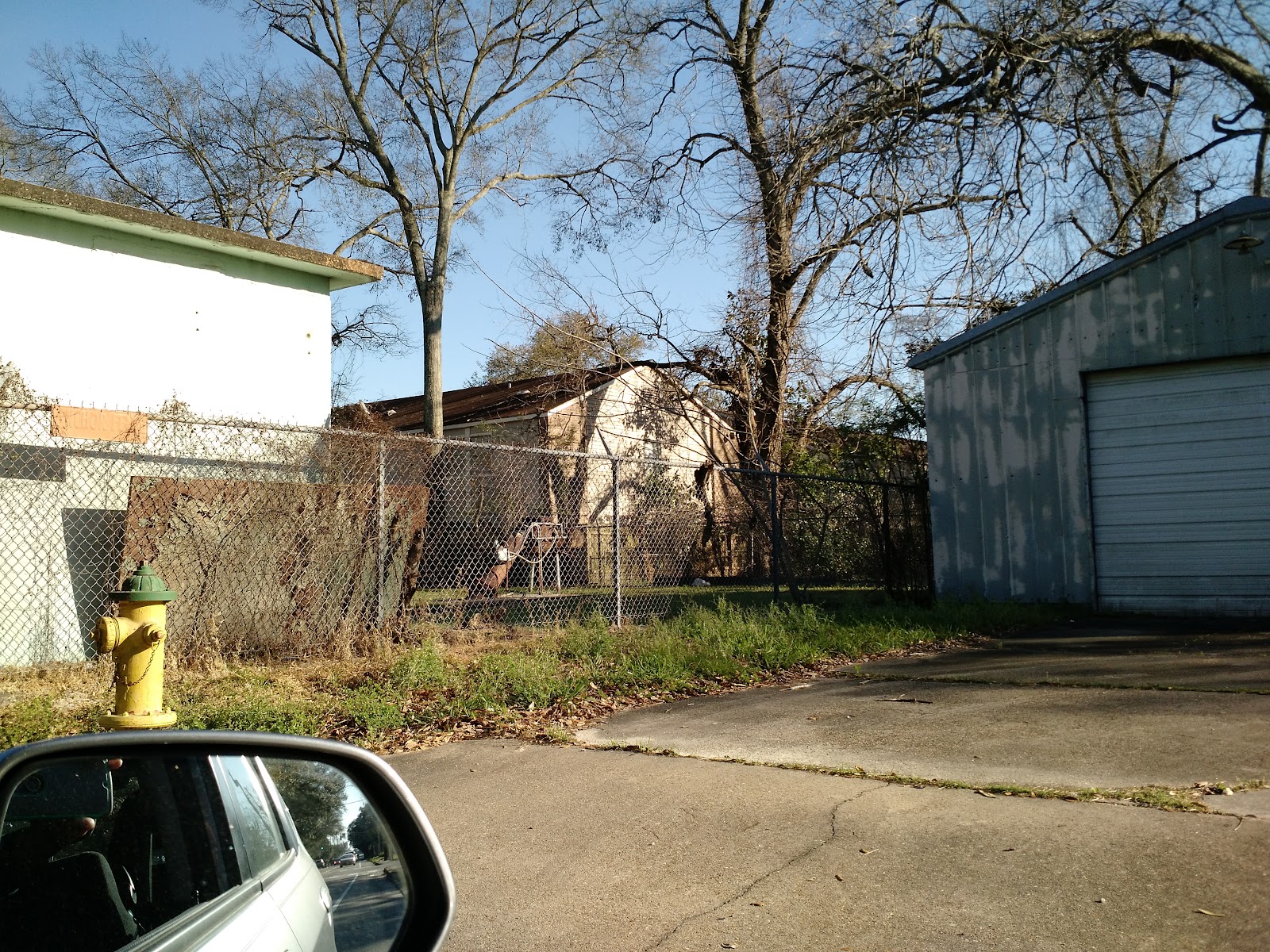
  • LUS Water Well #10 on Moss St at Park is no longer in production and has been described as abandoned (see attached photo).
  • The abandoned Grant Street Power Plant is unsightly and a public hazard from contamination.

At the meetings, residents gave a number other examples with which I was not familiar. In summary, the ECI draft final plan seems hypocritical when we see the apparent neglect received for care of City properties within the corridor. 


LUS Well 10 at Moss St at Park is abandoned and clearly looks the part! The photo is also available at the link https://goo.gl/f21aZn


PROJECT SPECIFIC COMMENTS


Iconic Structures
Throughout the I-49 Connector discussions and resident protests, we have heard of plans to build an ill-described bridge to signify the progressive nature of Lafayette. This seems to have moved forward and influenced the proposal for a Gateway Feature (project Gateway B). First, this is an idea that is ripe for ridicule. It is hard to see why the LCG and DOTD would provide such an opening in a community that can’t even fund a school tax. Tax opponents will use this as a hammer to destroy the whole ECI and Con programs. Second, we already have a beautiful gateway structure, our visitor center. We need a gateway that embodies Cajun and Creole culture, not a steel bridge or weird art. Those are fine for other places, but people visit us for the culture, and the current visitor center represents us very well. I am deeply saddened that DOTD plans to destroy the current center, and have been told that replacement will need to be at Parish taxpayer expense because we should have known better than to build it at its current location! In summary, rebuild the visitor center if the I-49 Con is ever built, and otherwise no iconic structure is needed.. 
 

Clay quarry
We have noticed that you plan to put a new park (project Gateway E) at what I believe is the old Clay quarry near the historic Lafayette brickyard and clay quarry (see The Attakapas Country: A History of Lafayette Parish, Louisiana by H. L. Griffin, p 52 and further) . This site is historically important in Lafayette. It is my understanding that most of the bricks for the old buildings in Lafayette came from this site. After the quarry was abandoned, it became a swimming hole for many of the young people in the city of Lafayette. The cool water that flowing freely from the now unconfined artesian aquifer must have provided cool recreation on hot days for many youth. However after two children drowned the council decided to fill the quarry. I am told that any fill materials that were available were used in filling the quarry including waste, trash and garbage - any sorts of materials that were no longer wanted. Today it is likely that this site not only provides contamination to the underlying aquifer and our water wells, but also may be a health hazard to nearby residents. Caution should be exercised in building a park at this location. 


Pedestrian bridge near Surrey Street
A pedestrian bridge near Surrey Street over the Vermilion is needed, and I am in firm support of the bridge proposed in the draft final report (project Vermilion E). I cannot recall ever crossing a less bicycle and pedestrian friendly bridge than the Surrey Street Bridge. Crossing on foot, I look up and down the road, then run as fast as I can to get across (tough job for an old man like me). There is absolutely no room for a pedestrian on this bridge if there are large vehicles passing at the same time. Do children attending the nearby Paul Breaux Middle School have to cross this bridge? I was thrilled to see the idea of a pedestrian bridge near this site suggested in the ECI report. I strongly support this idea.


Again, I thank the ECI team for the opportunity to provide public comment.

Sunday, May 14, 2017

Is it possible that the Louisiana DOTD would build an interstate without considering flood impacts?

By examining at some internet photos of last year's flooding you can see clearly that the answer is YES.

Here is a photo of flooding in Baton Rouge provided by Atmosphere Ariel to KTBS in August 2016.


And, from August 17, 2016, this is a photo of I-12 published by WDSU with an article titled "Walker mayor to sue state over I-12 construction."

An article in the Livingston Parish news states
The lawsuit says a 19-mile concrete barrier, from East Baton Rouge Parish to the Walker area in Livingston Parish is “acting as a man-made flood wall that interrupts the natural flow of surface waters.”

Is it possible that DOTD built these lane dividers without considering that they would act as a dam during heavy rain? It appears again that the answer is YES.

Now, the Louisiana DOTD wants to add large amounts of impervious surface in Lafayette by building the I-49 Con. Incredibly, the only mention of flood impacts in their Environmental Impact Statement is that they just plan to drain the roadway into local drainage or directly to the Vermilion. While they have taken decades to plan the I-49 Con, they have given the citizens of Lafayette nothing to gauge its flooding impacts. In past presentations, we have been told to trust them. We have been told that flooding analysis will be part of their final design. But, flood impact analysis should be a central part of the Environmental Impact Statement for public scrutiny and comment. Just ask the mayor of Walker how much he trusts DOTD's flood design expertise!

Proper flood mitigation would likely require construction of a large retention pond on land with an elevation above the highest historic flood height. Any private developer in our parish would be required to build retention/detention, but the DOTD is not constrained by local ordinances. I do not see any available large tract of land available within our urban center to accommodate the retention pond. Bypass alternatives to the east along the Teche Ridge, or west following the proposed LRX route would both have ample rural land available for such mitigation.

The most probable result of waiting until final I-49 Con design to consider flood mitigation is that there will be no flood mitigation.

Wednesday, April 26, 2017

Public comment from 16 years ago documents our citizens' struggle against the I-49 Con


Click on letter to enlarge.
The following comment by Kelly Roberts Caldwell dated April 30, 2001 was included in the FEIS, Volume II, page 299.  

Today, citizens continue to "battle a proposal that is, on its face, senseless." Now the senseless plan is called the I-49 Con.  


Secretary Kam Movassaghi
Department of Transportation & Development
P.O. Box 94245
Baton Rouge, LA 70804
Dear Sir:

The citizens of Lafayette fully support the extension of I-49 South. We strongly support a
Lafayette eastern bypass and are deeply opposed to an elevated interstate thru the heart of
our city. In July, 1992, a public meeting was held after an EIS was distributed of the Evangeline
Thruway corridor plan. Citizens voiced overwhelming opposition resulting in its withdrawal. In
1997, the project was restarted by DOTD at the urging of the chamber of Commerce leadership
who have relentlessly pursued the Evangeline Thruway placement. New strategy! Lead the
public to believe that other alternatives are being considered. Many reasonably assumed that the
1992 official public rejection eliminated Evangeline Thruway. Wrong! Residents realized very
late thai the "alternatives" were all simply "variations" of the previously rejected Thruway plan.

I am a spokesperson for a campaign by The Sierra Club, Citizens Speak Out, Sterling Grove
Historic Association, Tree Society of Acadiana, Annabelle Subdivision Association, and others
joined to promote an I-49 eastern bypass. Our petition has over 1000 signatures with more added
each day. Lafayette citizens arc now at risk from the 50,000 vehicles per day on Evangeline
Thruway, many hauling hazardous materials. Why plan to increase the risk with 100,000 daily
estimated for completed I-49? Proponents insist an eastern bypass was studied and rejected.
Rejected by whom? Where are the studies? Why choose this destruction and danger to our
community? ls it simply a price the local power structure is willing to pay to keep the project all
within Lafayette Parish - avoid sharing with our neighbor, St. Martin?

We are told a Lafayette eastern bypass would impact wetlands (though their plan requires moving
a runway at our airport into wetlands). Harold Schoeffler, a well known businessman and
environmentalist and Pierce Meleton, respected architect, and others actually mapped out a route
to the east between Breaux Bridge and Lafayette into St. Martin. It runs beyond Cypress Island
Swamp but west of the beautiful Teche thru sugar cane fields and pasture land coming back into
90 below Broussard. Destroys no homes or businesses. Gives St. Martin needed interstate
access and avoids the adverse impacts in Lafayette. Be vastly superior for evacuation- with two
highways out rather than the one sure to become an elevated trap in Lafayette. When taken to
highway engineers cost estimates were about half that of cutting thru lafayette. Likely you were
sent the St. Martin resolution asking that the Teche Ridge alternative be considered.

Citizens must battle to save themselves from a proposal that is, on its face, senseless? Impacts
to the human and natural environment so enormous that governments' talk of "mitigation" is a
joke in the community. An elevated federal interstate alongside a national historic district?
Elderly, poor and minorities disproportionately impacted? Their sector of the city walled of!?
Please do what you can.

Kelly Roberts Caldwell

Saturday, May 28, 2016

Expected Loss of Residential Property Values due to the Lafayette Connector

Source: Lafayette Consolidated Government,
Metropolitan Planning Organization
The old joke asks "What are the three most important factors in determining the value of a house?" The realtor answers "Location, location, and location." There is clearly some truth in this joke, and location close enough to an interstate highway to see it or hear it or smell it is clearly a negative.

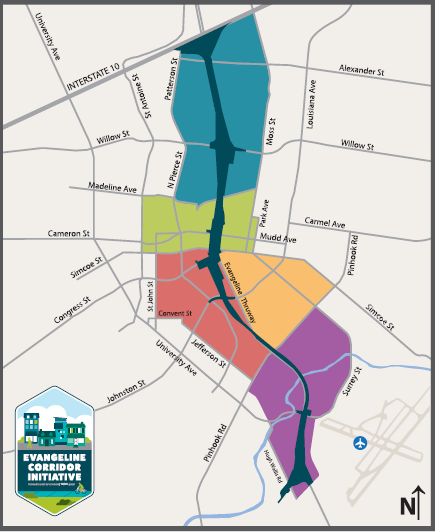
The area of impact of the I-49 Connector project has been wordsmithed by proponents into the project's "area of influence." The attached figure outlines this area of influence as defined by the Metropolitan Planning Organization (MPO). The question I'm asking here is "How much will home values within the impacted zone be depressed if the I-49 Connector project is built?" This is a vitally important question because for many residents their home is their greatest financial asset.

Residential property values of homes located near interstates are reduced because of noise, pollution, and appearance of the roadway. Taken together, these impacts on appraised value from being located close to an interstate are called interstate proximity stigma.

How much would the proximity stigma of the I-49 Connector reduce property values? Research looking at home sales from 2002-2005 within one mile of Interstate 90 in Seattle (Kilpatrick and others, 2007) confirmed the anticipated result - home prices closer to I-90 were lower, and prices more distant are higher. Under the researchers' model, a home 0.4 miles from the interstate lost 4% of its value relative to a comparable home one mile from the roadway; a home 0.1 miles from the roadway lost 13% of its value. Consistent with these findings, Clark and Herrin (1997) found a 10% reduction in value when homes were located within 0.25 miles of an interstate.

Thus, it is concluded from these studies, as well as common sense, that home values within the zone of influence would be reduced after construction of the I-49 Connector. A 10% reduction in value is a reasonable guess based on the cited research. Moreover, it is reasonable to further assume that houses in the impacted area will typically be harder to sell and will stay on the market longer than houses not suffering the interstate proximity stigma.


References:
D.E. Clark, and W.E. Herrin (1997) "Historical preservation districts and home sale prices: Evidence from the Sacramento housing market" The Review of Regional Studies27.1 (1997): 29-48.

Kilpatrick, J.A., R.L. Throupe, J.I. Carruthers, and A. Krause (2007) "The Impact of Transit Corridors on Residential Property Values" Journal of Real Estate Research 29(3):303-320.