Showing posts with label Flooding. Show all posts

Friday, March 15, 2019

February 2019 LRX Public Meeting Comments

The comments below were submitted on March 15, 2019. The February public meeting that solicited these comments presented the Tier 1 Environmental Impact Study for the Lafayette western bypass termed the Lafayette Regional Xpressway or simply the LRX. Learn more about the meeting and the LRX by reading the recent Connector Comments meeting announcement. It is available by clicking HERE.

The period for public comments closes on March 18, so you may still have time to submit your statement of support, concerns, or questions. Although the attached comment is quite detailed, short comments simply stating support and/or concerns are of great value and provide evidence of public interest.

The meeting slide show included this information on how to provide written comments after the meeting:
  • Send comments to: HNTB Corporation,10000 Perkins Rowe, Suite 604, Baton Rouge LA 70810,
  • or, Email comments to kbprejean@hntb.com
  • Comments received or postmarked by March 18, 2019 will become a part of the record.

If you have submitted or do submit comments through one of these methods, please consider sharing your comments with us by pasting then in the comments section at the end of this article. However, do be aware that comments on this Connector Comments site are not official, so be sure to submit official comments as described in the bullets above.


__________________________________________________________

Comments of Michael G. Waldon, PhD
Following LRX Public Meeting February 28, 2019


The following comments are my comments submitted in response to the request for public comments at the Public Hearing held in Lafayette on February 28, 2019.
I have divided my comments into the following topic-related sections.

Statement of appreciation
Relationship to other projects and needed model scenarios
Where is the Eastern Corridor?
Arkansas example - phased funding and completion
Flooding
Preferred corridor selection
Public information and participation
Public support
2005 Study Corridor Map


Statement of appreciation

I first sincerely thank the LMEC for holding this hearing and giving the public an opportunity to share our support and concerns. Thanks is also due to the visionary citizens of Lafayette who saw almost two decades ago that the only viable path forward for a north-south interstate connecting I-49 segments was a bypass. At that time, the so-called I-49 Connector, the “Con,” was seen to be effectively dead; killed by fierce public opposition, environmental infeasibility, and legal challenges. And rightfully so.


Relationship to other projects and needed model scenarios

If we cannot call the LRX an alternative to the I-49 Con, then at least allow us to call it a substitute.

Although our Louisiana DOTD continues to waste many tens of millions of federal tax dollars on planning the I-49 Con, it is even less viable today than in the early 2000s when it was effectively abandoned. Today’s advancements in geochemical science provide an even better understanding of the environmental risk of further contamination of the Chicot aquifer, and there is a renewed concern for flooding since the 2016 regional flood disaster. Additionally, the massive negative impact of urban interstates, particularly on poor and minority communities has become even more apparent than it was  decades ago. The Con is today quite simply inviable (i.e. dead). For years the LRX plans were stalled in order to not “distract” the public with the promise of a substitute for the locally opposed Con. Let us delay no longer. The LRX is our most advanced proposed substitute for the failed Con, and I urge our professional, political, and civic leaders to now give its development their enthusiastic support. Lafayette does urgently need the LRX project. Although completion of the LRX may be far in the future, every distraction coming from the Con, and every other delay simply moves LRX completion further into that future.

If ever built, the I-49 Con is almost certain to be partially toll funded (https://connectorcomments.blogspot.com/2016/06/the-specter-of-tolls-on-i-49-connector.html). Former Secretary of Transportation Dr. Kam Movassaghi was quoted (The Independent, April 14, 2009) saying that tolls must be considered for funding I-49 construction. An expert speaking to a meeting sponsored by our Chamber of Commerce affiliate One Acadiana (The Advocate, October 22, 2015) suggested that a toll of $0.19 per mile might be used to fund I-49 completion, and an Advocate article (September 22, 2014) reported that a state funded feasibility study looked at $0.18 per mile for I-49 funding. Former State Senator and then I-49 South Coalition Director, Mike Michot, was quoted in that same article saying about I-49 South "It seems unlikely a project of that magnitude will be built without the help of toll dollars."

The infeasibility of building the I-49 Con project is highly relevant in planning for the LRX, as is the prospect of the Con also having tolls. Additional model scenarios need to be considered for LRX planning. First, the scenario that the I-49 Con will never be constructed needs to be considered as a scenario because this is in fact most likely. Second, the scenario that the I-49 Con is built but has tolls must be considered. Adding tolls to the I-49 Con in modeling will increase traffic flow and toll revenue of the LRX. Failure to include these added scenarios related to the future I-49 Con seriously impairs planning for LRX traffic and toll revenue. Failure to consider these scenarios could negatively impact Louisiana's financial negotiations in dealing with the private PPP project partner for the LRX. 

It seems relevant to mention here that despite the tens of millions of dollars already spent on I-49 Con planning, to-date the DOTD has refused to include an I-49  toll scenario, or to incorporate the LRX in any I-49 Con traffic models. To members of the public this appears to be a blatant attempt to inflate traffic projection to thus justify the Con project. This concern is relevant here because I hope that such manipulation of planning results is not a part of the LRX project. A refusal to run the added scenarios listed here would lead to a similar but opposite appearance. It would lead the public to think that the LMEC and DOTD are purposefully failing to consider scenarios in order to “put their finger on the scale” giving preference to the Con relative to the LRX substitute.

In summary of my concerns stated in this section, I am asking that two LRX planning scenarios (model runs) be added for projection of traffic and toll revenue. First, projections are needed for the most likely future in which the I-49 Con project is abandoned and never built. Second, The scenario that the I-49 Con is constructed as a toll funded project is additionally required. Planning for the LRX that does not consider these possible futures would have little credibility in the eyes of the public. 

Where is the Eastern Corridor?

Earlier LMEC documents map an eastern corridor extending from I-49 north of Carencro to I-10 west of Breaux Bridge. Documents include “TECHNICAL MEMORANDUM 4: ENVIRONMENTAL RECONNAISSANCE” dated February 2005, “LAFAYETTE METROPOLITAN EXPRESSWAY FEASIBILITY STUDY EXECUTIVE SUMMARY IMPLEMENTATION PLAN”  dated June 2005. Figure 4-1, “Study Corridor Map,” from the 2005 Technical Memorandum 4 is appended to the end of these comments for the reader’s convenience. I have seen no published planning or engineering study, or any rationale for dropping the eastern segment. Was a decision made to drop this option? Does any documentation of the decision exist and was the public invited to comment on the decision?

For many years local citizens have supported an eastern route bypassing Lafayette following the high ground of the Teche Ridge. Here are a few of the links demonstrating this long-term support information on this proposed roadway:
     Kelly Roberts Caldwell spokesperson comments for Lafayette citizen groups in the I-49 Connector FEIS, Volume II, page 299  dated April 30, 2001 https://connectorcomments.blogspot.com/2017/04/public-comment-from-16-years-ago.html
     Connector Comments blog, May 27, 2016, “The I-49 Lafayette Bypass Option: Teche Ridge” https://connectorcomments.blogspot.com/2016/05/the-i-49-lafayette-bypass-option-teche.html
     I-49 Teche Ridge Bypass Facebook page https://www.facebook.com/I-49-Teche-Ridge-Bypass-191859984503529/
     Harold Schoeffler’s presentation to the St. Martin Parish Council on February 16, 2016 https://soundcloud.com/mike-waldon-906517104/hschoeffler-stmartinparish-2016-02-16

Some have suggested that such a roadway might begin as a two lane expressway and expand where needed to four lanes. Combined tith the LRX, the Teche Ridge eastern bypass would provide Lafayette with a full loop. This would improve traffic, efficiency of travel, and attract desirable economic development to communities in both Lafayette and St. Martin Parishes.

This comment is directly relevant to the LRX plan because it appears that the proposed eastern corridor was aligned to connect with the eastern Teche Ridge bypass which has been so long supported by citizens here. While I understand that the LMEC desires, as far as possible, to keep roadway development within Lafayette Parish, it seems arbitrary and wasteful to drop the eastern corridor from all consideration. I ask that future planning include this eastern corridor as a potential future extension. 

Arkansas example - phased funding and completion

The Bella Vista Bypass (Arkansas Hwy 549) is being constructed in Arkansas as a part of their I-49 completion. I believe this is a good example of a state (Arkansas) listening to public concerns and developing a bypass rather than running the interstate through the heart of a community. The Bella Vista bypass has been designed and is being and constructed by ARDOT. It is being constructed one segment at a time as funding becomes available. While in Lafayette we are mired in I-49 planning that will likely never lead construction, Arkansas is building a highway. The Bella Vista Bypass is initially being constructed as a two-lane expressway which will be expanded to four lanes as funding permits. Arkansas has been able to design a viable project which will likely be completed long before we even begin construction. I urge the LMEC and Louisiana DOTD to consider using a similar incremental approach for the LRX. You can learn more about the Bella Vista Bypass from the Wikipedia article titled “Arkansas Highway 549,” by Googling news articles, and by downloading ARDOT project documents.

Flooding

In an urban setting such as the I-49 Con, finding hundreds of acres outside the flood zone for runoff retention is at-best expensive and at-worst impossible. However, in the rural setting of the LRX this is less of a problem and may actually be viewed as a project benefit. I urge the LMEC to make flood impacts from the LRX project an integrated part of planning. In other projects the Louisiana DOTD has been accused of failing to adequately consider flood impacts of their projects. My understanding is that, as a state agency, DOTD is not required to follow local ordinances requiring runoff retention or other flood impact analyses or mitigations. In spite of this I ask that the LMEC pledge to integrate runoff management planning into every level of LRX design including the plan development for roadway routing. In the rural setting of much of the LRX, retention ponds can actually be an aesthetic feature while possibly providing needed fill for roadway elevation. Landowners may also welcome retention ponds as neighboring features which improve property values and provide alternative drainage for development.  

Preferred corridor selection

I agree with the selection of the preferred corridor identified in the meeting handout. Not only does this selection best meet the criteria in the selection matrix, It is the alternative which may most quickly be constructed.

Public information and participation

At the public hearing I voiced my concern that the LRX web site (www.lrxpressway.com), was not being maintained, and information on the site appeared to be years out-of-date. I also noted that information from the 2017 public hearing had not been posted to the site as had been promised to me at that meeting. Following the 2017 meeting, I did try on multiple occasions to contact anyone from the LMEC about this, but was unable to do so using the outdated information then available on the web site. If I had expended more effort I could have likely made contact, but such a level of effort should not be required for a member of the public to simply get information.

I have additionally tried to find the schedule for the quarterly LMEC meetings, meeting agendas, and meeting minutes. As a public body in Louisiana, there are requirements that these be available on the web site. However, such information was not on the LRX web site. Following the February public meeting, I was told that some of this information is actually on the LEDA web site. However, I have not found this information on either the LEDA web site or the LRX site. The LRX website has an LMEC meeting page which is reached from a link on the “about LMEC” page:  www.lrxpressway.com/lmec-meetings/
However this page refers to the schedule of the 2011 meetings, and even that information is incomplete.

Please post on the LRX website all documents required by law and publish timely announcements of the quarterly LMEC meetings. At a minimum LMEC must meet the requirements of the Louisiana open meeting law, but I hope LMEC will exceed these requirements by actively seeking public involvement.

Since the February 2019 meeting, I do see that LRX public meeting materials have been added to the LRX web site for 2019, and prior public meetings including the 2017 public meeting. These posted documents have been useful and I thank the LMEC for providing them. However, I am unable to locate agendas, calendars, or minutes for the legally required quarterly meetings of the LMEC. I request that these either be provided on the LRX site, or that a link be placed on the LRX web site to wherever these documents are archived. I also ask that LMEC meeting announcements be prominently posted on the LRX website along with the agendas for upcoming meetings so that the public and media may attend.

Public support

There was a clear demonstration of the public’s interest in the LRX project shown by the standing-room only crowd at the February public hearing. Although I did hear mild concern from a few potentially impacted property owners, I did not hear a single person comment that they were opposed to this project. This stands in stark contrast to the near unanimous public opposition concerning the I-49 Con voiced at every public meeting held over more than two decades by DOTD and others. The public is not timid in voicing opposition, and I felt that the lack of any expression of opposition toward the LRX, as well as the many positive voices of strong support, together give an indication that the LRX project can be successful. The LRX can be a valuable addition to our region’s transportation infrastructure. I support its development. Thank you again for this opportunity to comment. 


2005 Study Corridor Map
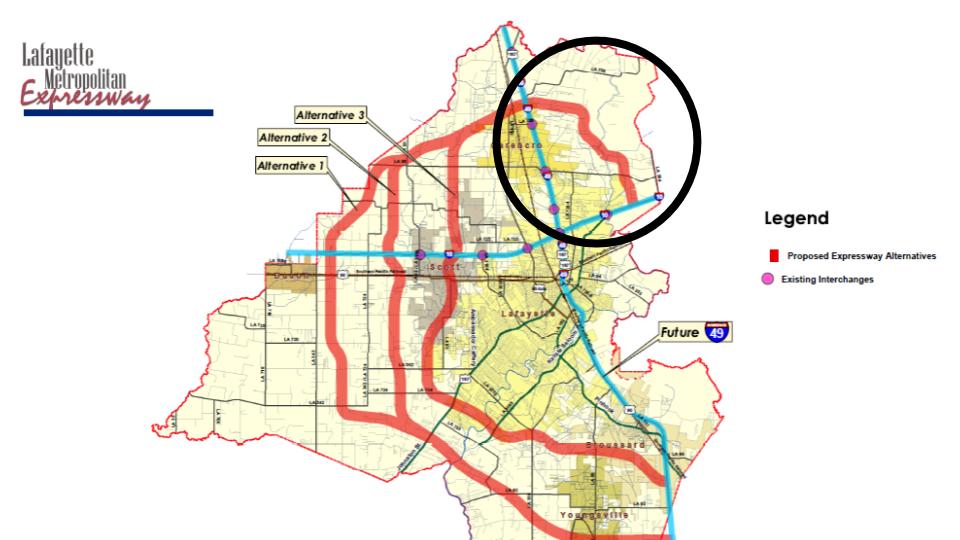


February 2005 “Study Corridor Map” from Figure 4-1 in the report “Lafayette Metropolitan Expressway, Technical Memorandum 4, Environmental Reconnaissance.” The black circle was added to the figure to indicate the segment termed the eastern corridor in these comments.


Michael G. Waldon, PhD
Resident of Lafayette Parish, Louisiana

March 15, 2019

Thursday, June 29, 2017

LFT Airport Update


(Why is there a $200 million problem looming at LFT? Be sure to read to the end to find out.)

A presentation on the current status of the Lafayette Airport (LFT) and planned airport renovations was an agenda item for the June 20, 2017 Lafayette City/Parish Council meeting. Presenters were Valerie Garrett, Chairwoman of the Lafayette Airport Commission, and Steven Picou, LFT Executive Director. Paul Guilbeau, Vice-Chairman of the Lafayette Airport Commission was also in attendance. Their summary update document provided by the Council Clerk is available here.


View the 12 minute video of the airport update by clicking here or view it in the frame at the bottom of this post.

STEVEN L. PICOU
LFT Executive Director

Steven Picou's update summarized these points:

  • LFT has hired their Program Management/Construction Management (PMCM) firm
  • 5000 citizens gave public input that contributed to the selection of the Journey renovation design
  • The Disadvantaged Business Enterprise (DBE)program at LFT is a priority
  • Part 139 inspection had zero discrepancies
  • LFT is prepared for tropical storms and hurricanes
  • Past year's cargo handling of 24.6 million pounds is up from the prior year 
  • The cargo handling facility is opening, UPS and Fed-X are moving in

The I-49 Connector plan requires moving a runway at LFT -

Dr. Michael Waldon asked during public comment if the runway displacement required by the I-49 Connector project would result in any changes to the renovations. He also cited his minimum safety requirement calculation that shows that the displacement would need to be 860 feet rather than the 350 feet stated in the I-49 FEIS. This calculation was published last year in the ConnectorComments.org post titled Airport angles and increased risk. Mr. Picou replied that he had not seen the published recalculation of the displacement. Further, he said that new FAA regulations would require an additional 1000 feet of runway if it is reconstructed. Mr. Picou stated that the airport "has hired a firm to look at that information." Currently the airport is constructing an EMAS system (engineered materials arrestor system) at the end of this runway. He also said that Dr. Kam Movassaghi had led a student design project that might eliminate or reduce the required displacement, but DOTD has not reported any study of such options.

District 9 Councilman Theriot asked whose responsibility would it be if the runway had to be displaced. Mr. Picou answered that FAA has taken the stance that it is not their responsibility, and it is not the airport's responsibility. He went on to say that in his opinion "It is Federal Highways responsibility." FAA takes the stance, he said, that millions of their dollars have already been spent on the airport, and it is not their responsibility.

The bombshell of the evening occurred when Councilman Theriot followed up by asking what the cost would be. Mr. Picou replied that a rough order-of-magnitude estimate is $200 million dollars. In part, this cost is so high because the FAA would no longer allow the use of an EMAS at this end of the runway, which results in an added runway length requirement of 1000 feet.

While there may be intergovernmental discussion of which tax dollars will fund this $200 million (or more), in the every case it is taxpayers who will pay and citizens who will suffer added flooding from the loss of flood storage currently provided to Lafayette and St. Martin Parish residents by the Cypress Island Swamp.


LPC-AirpotUpdate-2017-06-20 from Mike Waldon on Vimeo.


Sunday, May 14, 2017

Is it possible that the Louisiana DOTD would build an interstate without considering flood impacts?

By examining at some internet photos of last year's flooding you can see clearly that the answer is YES.

Here is a photo of flooding in Baton Rouge provided by Atmosphere Ariel to KTBS in August 2016.


And, from August 17, 2016, this is a photo of I-12 published by WDSU with an article titled "Walker mayor to sue state over I-12 construction."

An article in the Livingston Parish news states
The lawsuit says a 19-mile concrete barrier, from East Baton Rouge Parish to the Walker area in Livingston Parish is “acting as a man-made flood wall that interrupts the natural flow of surface waters.”

Is it possible that DOTD built these lane dividers without considering that they would act as a dam during heavy rain? It appears again that the answer is YES.

Now, the Louisiana DOTD wants to add large amounts of impervious surface in Lafayette by building the I-49 Con. Incredibly, the only mention of flood impacts in their Environmental Impact Statement is that they just plan to drain the roadway into local drainage or directly to the Vermilion. While they have taken decades to plan the I-49 Con, they have given the citizens of Lafayette nothing to gauge its flooding impacts. In past presentations, we have been told to trust them. We have been told that flooding analysis will be part of their final design. But, flood impact analysis should be a central part of the Environmental Impact Statement for public scrutiny and comment. Just ask the mayor of Walker how much he trusts DOTD's flood design expertise!

Proper flood mitigation would likely require construction of a large retention pond on land with an elevation above the highest historic flood height. Any private developer in our parish would be required to build retention/detention, but the DOTD is not constrained by local ordinances. I do not see any available large tract of land available within our urban center to accommodate the retention pond. Bypass alternatives to the east along the Teche Ridge, or west following the proposed LRX route would both have ample rural land available for such mitigation.

The most probable result of waiting until final I-49 Con design to consider flood mitigation is that there will be no flood mitigation.

Saturday, July 2, 2016

Airport angles and increased risk

SUMMARY: Because this is an unusually long post, you may wish to skip first to the SUMMARY at the end of this post before reading the entire post.

A LOT has been written on the topic of "things you just should never do."  One of these "never do" actions is to build tall structures next to your airport. This is precisely the DOTD plan for extending I-49 through Lafayette.

In an earlier post I talked in general about the problems associated with the Connector plans relative to the Lafayette Airport. In this post. I want to get down to specifics.

Figure 1.  Google Earth image of the northwest end of runway 11-29 in relation to the intersection of Evangeline Thruway, University Ave, and Surrey St.  

Federal safety guidance defines the maximum height that objects should not exceed in the vicinity of airports. This definition is based on a number of imaginary surfaces through which no objects sitting on the ground should penetrate. Keeping aircraft above the imaginary surfaces, and all terrestrial objects below, provides for safe landings and takeoffs.

The lowest of these imaginary surfaces, the primary surface, is a rectangle at the elevation of the runway. The primary surface extends 200 feet beyond each end of the runway and 500 feet on each side of the runway centerline. Beyond each end of the primary surface there is an approach surface. The approach surface begins at the primary surface elevation and rises, for runway 11-29, at a slope of 34:1 (termed a 3% slope). That is, for every 34 feet of center-line distance the surface rises 1 foot.  At their intersection, the width of the approach surface is the same as the primary surface, 1000 feet, and is centered on the runway center-line. The approach surface widens to 4000 feet at 10,000 feet ground distance from the primary surface. That is, the approach surface width is 1000+0.3x, where x is the ground distance along the center-line away from the primary surface. There are other defined surfaces (transitional surface, horizontal surface, conical surface), but only the primary and approach surfaces are relevant to the issue of runway displacement for 11-29.

The 2002 Final EIS asserts in numerous locations that the Lafayette Regional Airport runway 11-29 will need to be displaced 350 feet to the southeast toward Bayou Tortue and Cypress Island Swamp from its present location to meet minimum federal safety requirements for an approach surface slope of 34:1 and a 17 foot margin of safety (FEIS exhibit 4-4). While the FEIS makes the assertion that the 350 foot displacement is required, it does not show the underlying data or rationale needed to support the claim. I have therefore been forced to attempt to recreate these calculations. My calculations, however, do not agree with the conclusion in the FEIS. Lacking documentation of the FEIS methods, I conclude that the 350 foot assertion is likely in error.

A history and general information about the Lafayette Regional airport may be found in the Wikipedia article titled "Lafayette Regional Airport." Additional information on the airport AirNav.com. That web page also includes a link to a useful Airport Diagram. The diagram shows that runway 11-29 is 5401 feet long and 148 feet wide. Elevation at the northeastern end (designated 11) is 37 feet; elevation at the southeastern end (designated 29) is 35 feet.

Figure 1 is an image captured from Google Earth of the northwest end (designation 11) of runway 11-29. It illustrates that the runway does end quite close to the current highway. Measurement shows that the runway currently ends roughly 600 feet from Evangeline Thruway (Hwy 90), and roughly 700 feet from the intersection of the Evangeline Thruway, Surrey St, and University Ave.

Figure 2. This image is extracted from the FEIS Plate 2a2. North in this figure is to the right, and distance along the horizontal extent of the roadway in hundreds of feet is given on the horizontal axis; elevation in feet (NGVD 29 datum) is plotted on the vertical axis. The roadway is charted as the solid black line. The 40 foot elevation is highlighted by a dotted red line. Peak roadway height at the interchange is estimated to be 45 feet. 


Finally, it is necessary to estimate the height of objects above the roadway. This could include signs, streetlights, and aircraft warning lights. The FEIS does mention this, and suggests that special signage and lighting may be necessary. Thus, I will assume that the height of the vehicles on the roadway will be the tallest objects above the roadway. There is no Federal vehicle height requirement for commercial motor vehicles (CMVs). Most eastern states, including Louisiana, set a CMV height limit of 13.5 feet on most highways. Louisiana does allow heights of 14 feet on designated highways, and oversize permits can be routinely issued for heights up to 16 feet 5 inches. Without specific guidance from the Louisiana DOTD, it is unclear what height should be assumed. Here, I will simply assume a maximum height of 15 feet for all vehicles and objects on the roadway.

Assuming the peak height at the interchange structure controls the required runway displacement, the calculation of length for the approach surface is now straightforward.  The interchange height plus object height has an elevation of 60 feet (45+15). Adding the FAA 17 foot margin of safety gives a total elevation of 77 feet. Subtracting the runway height which defines the primary surface elevation then gives a height of 40 feet (77-37). At a slope of 34:1, the length of the approach surface to the primary surface is 1,360 feet (34x40). At this point along the approach surface, the approach surface width is 1408 feet (1000 + 0.3x1,360), or 704 feet on each side of the extended runway center-line (Figure 3). Adding the 200 foot width of the primary surface at the end of the runway gives a total distance form the peak of the interchange of 1,560 feet. The present distance is estimated to be 700 feet, so the total runway displacement required would be 860 feet (Figure 4). This is 510 feet longer than the value asserted in the FEIS. This difference significantly brings into question the economic, environmental, and engineering feasibility of the displacement.

Figure 3. The more northern half of the new approach surface (black outlined trapezoid) begins with a width which is 500 feet on either side of the extended runway centerline, and 200 feet beyond the new runway end (orange line). The distance to the centerline extends to 704 feet at the proposed elevated interchange.

The calculated extension will require very roughly the destruction of 45 acres of the Cypress Island Swamp west of the airport (Figure 4), and more if embankments in the swamp must be longer than existing embankments. This considerably exceeds the 5 acres estimated in the FEIS (p 4-92).

(a)

(b)
Figure 4. The upper figure (a) shows the current airport runway at the southeast end of runway 11-29. The lower figure (b) is the same image with an 860 foot length of runway and associated area is copied onto the current end of the runway. The original image was printed from Google Earth. 
Construction would require significant fill, and consolidation of the underlying wetland soil will further aggravate the existing problems of soil stability at this end of runway 11-29.  The FEIS on page 2-10 states that "a prior runway extension of about 200' constructed in 1967 has subsided up to approximately four feet and has been removed from service." This fill will encounter even greater engineering challenges.

The new extension into the swamp will need to deal with a very significant drop in elevation (Figure 5). As much as 35 feet of fill will be required for the extension. If earthen embankments are used at the sides of the filled area, considerably more than the estimated 35 acre area of wetland may be required in order to accommodate the more extensive embankment areas.

(a)
(b)
Figure 5. In (a), the center line of the runway (red line) is extended at the southwest end of runway 11-29. The green bar indicates 860 feet from the end of the center line, and the thin white lie crossing the center line is 860 feet from the runway end. Figure (b) graphs elevation along the center line from 39 ft to 4 ft.  


Options: What are our options? They include:
  1. The No Build alternative should always be considered. If the currently planned I-49 Connector project is abandoned, it could be replaced by upgrades to the current Evangeline Thruway, and bypass to the east along the Teche-Ridge, west using the LRX alignment, or both to form an urban loop.
  2. Build the connector project as decided in the FEIS and ROD, and extend runway 11-29 as required to meet minimum FAA guidelines. This will require land acquisition and a Corps of Engineers wetland permit. Likely this alternative will further require wetland mitigation and flood mitigation.
  3. Build the connector project as decided in the FEIS and ROD, and request an FAA exemption from airport approach obstacle safety requirements.
  4. Abandon use of runway 11-29.
  5. Revise the design in of the selected alternative to eliminate roadway elevation in the vicinity of the 11-29 runway approach surface.

SUMMARY: The I-49 Connector FEIS identified unacceptable risk due to failure to meet FAA flight path obstruction guidance, resulting from the proposed interchange construction adjacent to the Lafayette Regional Airport. Without documenting calculations or rationale, the FEIS stated that in order to meet these minimum safety requirements, airport runway 11-29 would need to be displaced 350 feet southeast toward Bayou Tortue and the Cypress Island Swamp.

My calculations, based on FAA guidance, arrive at runway displacement considerably longer than that presented in the FEIS. Here, following FAA guidance, I calculated that the required displacement is 860 feet. This significant difference brings into question the economic, environmental, and engineering feasibility of the displacement. Impact of this displacement on flooding, wildlife, and wetlands should be carefully addressed and documented by DOTD.

The public attitude toward airport safety should always be conservative and circumspect. The Airport's 1975 Master Plan concludes "Conditions at the airport's periphery make expansion of its land area difficult or expensive or both." Even beyond the impacts of runway displacement discussed above, it is simply inappropriate to choose to construct any tall structures on the periphery of our airport which is already severely constrained at its location. Tall structures like the University and Kaliste Saloom interchanges constrain future airport runway alignment adjustments, and impact the ability to meet current requirements and future safety requirements should FAA guidance on safety margins or approach slopes change for any reason.


Friday, May 27, 2016

The I-49 Lafayette Bypass Option: Teche Ridge

Google Earth image showing the approximate path of the
proposed Teche Ridge bypass.

For nearly two decades, Acadiana residents and taxpayers have urged DOTD to consider an I-49 bypass option following the Teche Ridge in St. Martin Parish. This roadway would follow along the natural ridge that follows west of Bayou Teche. This area has few wetlands, does not flood, and is primarily in agricultural use. An engineering feasibility study, funded in part by the St. Martin Police Jury, was completed by the engineering firm T Baker Smith.

And, as taxpayers the difference in estimated cost is staggering. The 5.5 mile I-49 Connector (Divider) is estimated to cost over $1 billion, while the 20 mile Teche Ridge route would cost far less than one third of that total. This is over $200 million per mile for the Connector before costs of toxic waste cleanup and flood control are even considered. The 20 mile Teche Ridge route would cost a more conventional $15 million per mile.

The Teche Ridge route would obviate extending the Lafayette Regional Airport runway into the Cypress Island Swamp, avoid issues of diminished airport safety, obviate wetland loss from fill, and obviate induced flooding associated with the airport revisions. It also greatly improves resilience of hurricane evacuation for the large population living south of Lafayette.

Furthermore, the Teche Ridge route could be a part of a larger project to provide a bypass loop around our urban core. Combining the Teche Ridge route with the western Lafayette Regional Xpressway (LRX) would give Lafayette a full urban interstate loop. Now, note that this 80 mile loop would cost approximately the same as the 5.5 urban Divider being forced on our taxpayers and neighborhoods.


For more information on the Teche Ridge, check out these resources:

Teche Ridge Bypass Facebook page
  https://www.facebook.com/I-49-Teche-Ridge-Bypass-191859984503529/

Presentation by Harold Schoeffler to the St. Martin Parish Police Jury
 https://www.facebook.com/michael.waldon/posts/10204527887710661

Teche News article on the Teche Ridge Highway alternative.

The Daily Iberian, February 17, 2016, Teche Ridge I-49 proposal gets traction in St. Martin


Thursday, May 19, 2016

How big will the I-49 Connector retention pond be? Where will we put it?

Retention/detention pond behind the new Costco store in Lafayette, Louisiana.
photo credit: M. Waldon, no rights reserved


The Lafayette I-49 Connector project envisions a new 5.5 mile highway project going through Lafayette. Where will its storm water drain? The 2002 Environmental Impact Statement simply says it will drain directly into the Vermilion at its southern end, and into local drainage which flows to the Vermilion in its central and northern sections. Even in 2002, it must have been apparent that this could impact flooding. Today, we generally require retention/detention ponds to hold back flows from new construction so that no added flooding results from new projects. These ponds also reduce water pollution by settling out some pollutants How could this not be a major topic of discussion today?

Let's do a "back-of-the-envelope" calculation to get an idea of how large the pond or ponds must be. The project is 5.5 miles (29,040 feet) long, and average width is, I'm guessing, about 600 feet. Multiplying gives 17.424 million square feet of total project area. There are 43,560 square feet in an acre, and division gives 400 acres for the entire project area.

A big 3-day rain event in Lafayette can drop a lot of rain, and we need to plan for the really big storms to avoid flooding. At times we have gotten over 20 inches of rain in one day, so I will assume for planning that we get 30 inches in a 3-day event. Of this rain, some runs off, and some is retained or evaporates. For a typical residential, industrial, or open area, 20% to 60% of the rain might run off. Here, I will assume that 30% currently runs off to the Vermilion. For developed areas with significant impervious surface and sloped, compacted, and drained soil, 80% to 95% might run off. Here, I assume 85% runs off. So, 55% more of the rain is expected to run off after the project is completed. This is 16.5 inches (1.375 feet) of new runoff.

The total volume of added runoff is therefore 400 acres times 1.375 feet, or 550 acre-feet of water. Therefore, the pond needs to provide a storage volume of 550 acre-feet. If our retention pond has an average depth of 3 feet above the dry weather water level, then the pond must be 183.33 acres. Making room for shoreline and fence line (maybe even a jogging track), I assume the pond and related features will take up about 200 acres or 8.712 million square feet.  If square, this requires a property 2952 feet (0.56 miles) on each side.

Where in developed Lafayette can  we place such a feature? The pond must be downhill from the I-49 Connector to avoid the costs and uncertainties of pumping. Therefore, feasible placement of this pond is limited generally to the area between the roadway and the Vermilion channel. Further, any destruction of wetlands or residential areas should be avoided. Agricultural land might be an ideal choice, but we are unlikely to find such within the developed urban area within a feasible distance.

Thus, the question remains - How will we deal with increased flooding from the I-49 Connector? Will this be addressed by DOTD in their public meetings?

Sunday, May 15, 2016

Impact of I-49 on the Lafayette Airport


Construction of any tall structures at the end of one of an airport runway is, at best, ill advised. Such structures inevitably increase risk of disaster. Allowing such construction by the I-49 Lafayette Connector project would give travelers the perception that Lafayette has a depreciated value for traveler safety. The Lafayette Airport Commissioners represent the public and are tasked with overseeing airport management and promoting the airport. It therefore seems remarkable that The Lafayette Airport Commission has not strenuously objected to plans to construct the elevated I-49 interstate on the airport boundary immediately at the end of one runway.

The 1975 Lafayette Regional Airport Master Plan Report concluded that conditions on the airport's periphery make any expansion difficult, or expensive, or both. The current plan to reroute Bayou Tortue, fill an area of wetlands within the Bayou's floodplain, and construct a runway extension on this unsupportive fill

  • will be an engineering challenge, 
  • will be environmentally destructive, 
  • will be very costly, and 
  • will be politically sensitive. 
The now-obsolete project EIS fails to evaluate or even consider these impacts.
  
from Lafayette Regional Airport Master Plan Report, 1975, page 11.

Wednesday, May 11, 2016

Flooding and Drainage Issuse Not Addressed by DOTD


This graph displays velocity of water flow in the Vermilion at the Surrey Street
Bridge. A large rain storm occurred on April 30-May 1. Negative velocity shown
in the graph indicates that the Vermilion was flowing upstream in response to
the storm.  

Lafayette Parish flooding will be increased along the Vermilion River and its tributaries by the Connector project.

A big rainstorm occurred in Lafayette beginning April 30, 2016. Look at this graph of Bayou Vermilion water velocity at Surrey Street - the negative velocity (up to 2 feet per second) means the Bayou is flowing backwards fast! This has important implications for flood control and planning in our community. Much of our flooding happens from water stacking up in the Bayou with no way to flow south. Drainage "improvements" bringing higher peak flows into the Bayou south of the city can raise the stage so much that this downstream water actually flows north and creates a "water dam." Now, coulees draining the storm water from city neighborhoods must either fill the Bayou to higher levels (stages), or back up with no outlet. Many flood planning computer models ignore this "backwater effect." That's OK in most other places in the US, but literally disastrous for flood planning in South Louisiana. 

Video: Backwater in Coulee Mine Branch, Lafayette, La.

NOW - What action do you need to take? When planners for new projects say they have done careful computer analysis and determined that no new flooding will result from their project be very skeptical. Ask if they took backwater flooding into account for both their project near and upstream of their project. You will likely be met with ignorance, arrogance, and condescension, but do persevere. What projects? Well the I-49 Connector comes to mind.

AND - What analysis of flooding impacts did DOTD provide in their 2002 EIS for the I-49 Connector? Basically nothing. Their plan is to provide the very efficient drainage required by interstates, and route the water to the Vermilion either directly, through existing drainage structures, or using very large pumps. No accounting for flood impacts from this massive increase in impervious surface is even attempted. No proposals have been made to build stormwater retention/detention basins for the project. In the EIS, no consideration was given to the residential and street flooding that will result from the project. It is likely we will experience heavy rain during hurricane evacuation, and this planning deficiency is all the more alarming when hurricane evacuation is considered. 

There is a history of DOTD flood and drainage design along US-90 and I-49. During a heavy rain event in 2001, cars went underwater on Hwy 90 east of Broussard where Hwy 92 crosses US-90. Cars had to be routed over to the Teche Ridge area on Hwy 31. In the April 30 - May 1 rain storm The Advertiser (1) reported rainfall of over 10 inches. While this is large, Louisiana at times receives over 20 inches of rain in a day. Occurrence of flooding of the I-49 roadway just north of Lafayette is an alarming sign that the I-49 corridor is not well designed for hurricane or flood evacuation.


Photo: The Advertiser (1).


Further, some DOTD plans for the I-49 Connector call for excavating underpasses or even depressing large parts of the interstate roadway itself. As local citizens know all-too-well, below grade underpasses in South Louisiana have a problematic history (2). Reliance on large pumps makes travel during heavy rain events reliant on maintaining electric power at the pump stations (assuming electric pumps are used), or reliability of diesel-driven pumps and fuel delivery (if diesel power is selected).

1. The Advertiser, May 2, 2016, Flooding Sunday some of the worst seen in years http://www.theadvertiser.com/story/weather/2016/05/01/-49-close-due-flash-flooding/83787580/
2. KLFY, March 18, 2016, University Ave underpass near Cameron St OPEN after flooding
http://klfy.com/2016/03/18/university-ave-underpass-near-cameron-st-open-after-flooding/