Showing posts with label Human health. Show all posts

Monday, November 15, 2021

Comment: The Lafayette Connector project has failed to meet federal requirements for public involvement and environmental justice


From:
Mike Waldon 
Mon, Nov 15, 2021 at 3:56 PM
To: comment@lafayetteconnector.com
Cc: Josh Guillory, Charles Bolinger, Shawn Wilson, Monique Boulet, Tim Nickel, Col. Greg Ellison, Andy Naquin, Glenn Lazard, Liz Hebert, Nanette Cook, Patrick Lewis, Abraham Rubin Jr., Bryan Tabor, John J. Guilbeau, Joshua Carlson, Kevin Naquin

DOTD I-49 Open House

Subject: Comment for November 4, 2021 event transcript - Failure to address contamination and environmental justice

This is my public comment following the event that was called a "public meeting" held on November 4, 2021. I ask that my comment be included in its entirety in the public meeting transcript and the record of Lafayette I-49 Connector project comments.

It is misleading for the meeting transcript to call this a public meeting.  As with your previous meetings, the public was given no opportunity to openly provide comments or feedback. Simply providing an email address and comment cards is not adequate. This event would more accurately be called a poster session. 

This and other meetings held by the Lafayette Connector project fails to meet state open meeting law requirements (see my comment submitted October 19, 2017), and federal requirements for public involvement (https://www.fhwa.dot.gov/planning/public_involvement/orders/#a9).In the future, I urge the Lafayette Connector management team to follow not only the statutory and regulatory requirements for public involvement, but to also sincerely follow the spirit of open involvement on which these requirements were based.

This proposed state/federal urban interstate project completely ignores the issues of social justice, environmental justice, risk of severe health impacts on the predominantly disadvantaged community, and damage to property caused by spreading of toxic contaminants. This is in clear violation of federal requirements for public involvement. This project is in violation of Executive Order 12898, and the federal FHWA's published public involvement requirement to "assure that possible adverse economic, social, and environmental effects relating to any proposed project on any Federal-aid system have been fully considered."

Specifically, a large part of the proposed corridor of this project is heavily contaminated or likely to have contamination of soil and groundwater. This fact has been established in past court proceedings. However, the full spatial extent of contamination has never been publicly disclosed, and is likely unknown. Data and reports in possession of the Louisiana DOTD have been declared confidential by DOTD leaving the public ignorant of potential health risks that DOTD already knows about, or should know about after more than 30 years of floundering through design after design of this anachronistic project while avoiding knowledge of the risk and cost. 

Long ago when I was studying to be an environmental engineer, I recall learning that the first thing to do when considering working with a contaminated site is to determine the spatial extent of the contamination. After decades, the Connector project planners either have not made the determination of spatial toxic extent in the project corridor, or are not disclosing it to the at-risk public. In either case, this failure clearly violates federal policy including environmental justice requirements

We, the public, do have enough information about toxic contamination in the project corridor to know that it is an extremely serious risk. Indeed, neighbors of the railyard have sued seeking cleanup. We know that operating construction machinery over land contaminated with asbestos, arsenic, and lead risks spreading toxic dust through neighboring homes and businesses. If you want to give us poster sessions on your plans, show us how you will work in this toxic environment without further exposing us to toxic and carcinogenic chemicals through air, surface water, groundwater, and drinking water.

Likely, for over a century, contaminants have been eroded and followed drainage along Evangeline Throughway contaminating much of the surface soil in the corridor. Other contaminants have surely moved through the surficial aquifer under surrounding homes and businesses. It is known that the contaminants from the railyard migrated through groundwater off-site because Lafayette city/parish workers found and reported visible contamination off site near the railyard. 

We do not know the extent of migration of the contaminants from the contaminated railyard and other contaminated sites along the proposed route. However, we do know that in Houston a similar railyard has had significant off-property migration. Further, the State of Texas has confirmed that this contamination is coincident with cancer clusters in neighboring communities. 

The impact of the Lafayette Connector project on air and water toxic migration is vitally important to our community. The impact of toxic migration on design and construction of the Connector is vitally important to taxpayers who are paying for this project. A cleanup plan must be proposed for this project and must be disclosed to the at-risk public for public review and comment. This is not only a regulatory requirement, it is a moral and ethical requirement for those promoting this project. 

Finally, I address the engineers working on this project. How can you propose a project while remaining willfully ignorant of environmental consequences of your proposed actions on the surrounding community and construction workers? Every engineer  is ethically required to give protection of human life and property the highest priority. Doesn't the sequencing and planning of the I-49 Lafayette Connector project to-date breach your professional engineering ethical boundaries?

I am submitting these comments via email to comment@lafayetteconnector.com. I am also copying some interested members of the community, members of the I-49 Connector Executive Committee, and our City and Parish Council members. I will also send these comments in a separate message to US Secretary of Transportation Pete Buttigieg.

Thank you for considering my comments.

Michael G. Waldon, Ph.D.
110 Seville Blvd 
Lafayette, LA 70503 
337-852-3668, email: mike@mwaldon.com
November 15, 2021

Monday, June 22, 2020

Ozone and the I-49 Connector: Why should we care?

DOTD I-49 Urban Route.
Recent local news articles on KATC and in The Acadiana Advocate  reported an LDEQ warning that on June 19 Lafayette would have high levels of ozone. LDEQ declared an Ozone Action Day for Lafayette. Why should we care about ozone?

First, high ozone levels are a risk to health, particularly among our most vulnerable citizens. Those who work or exercise outdoors are also at risk.  

Second, Lafayette has in the past been close to non-attainment for ozone, while Baton Rouge has been out of compliance. Currently all of Louisiana is considered to be in compliance with the federal standard of 70 parts-per-billion for ozone. Lafayette air pollution has improved, but there are continuing calls to make the ozone standard more protective. Non-attainment matters to Lafayette's future economic growth which could be impacted by restrictions and new requirements placed on any industry wanting to locate here. Beyond that, the most sought after companies looking for a new location are far less likely to choose a city with recognized poor air quality. Bottom line: our current good air quality is a plus for Lafayette to recruit new economic development. 

Finally, what has ozone got to do with the I-49 Connector? If you listen to Louisiana DOTD and their consultants who are writing the I-49 Environmental Impact Statement you might think ozone and air pollution have nothing to do with their plan. But, our biggest source of ozone in Lafayette is from cars. Common sense tells us that the proposed elevated interstate through the heart of our city is going to concentrate heavy traffic on city streets that lead to and from the interstate. Further, much local traffic will avoid using the elevated highway because of its limited points of access and exit. Those cars and trucks will be forced to sit in traffic on city streets. And, if the Connector has tolls, expect even more traffic forced down to city streets. Expect troubling increases in ground level ozone.

LRX Bypass Corridor Options (DOTD)
This doesn't have to happen! The proposed Lafayette Metro eXpressway (LRX) would allow through traffic and hazardous cargo to bypass the central city. For almost two decades we the taxpayers have funded planning for the LRX bypass. It is time to act and choose this alternative. The LRX would draw traffic away from easily congested urban streets and save local tax monies as city street expansions are no longer needed. The LRX would improve rather than worsen ozone pollution in Lafayette. If the I-49 Connector is built, we will be stuck with its induced traffic congestion and resulting bad air in our city for decades. Let's just not go there! 


Thursday, June 7, 2018

What percent of known railyard contaminants are monitored by LUS in our well water?

In their letter delivered in March 22, 2017 to our City/Parish Council and Mayor/President , the Acadian Group of the Sierra Club and WaterMark Alliance made ten recommendations describing actions which are needed to protect the public's health and property. To date, our city "leaders" have not even shown the courtesy of acknowledging receipt of that letter, and have given no public indication that they are considering any of the recommended actions to protect their constituencies.

In that letter, recommended action #3 was to (emphasis added):
"Intensify sampling of well water by increasing the frequency of sampling and adding contaminants for analysis to include all known or suspected contaminants present on the surface or in the surficial aquifer (groundwater just below the surface)."
Why was increased water well monitoring by LUS recommended? Consider these facts that undergird the rationale for improving LUS's water well monitoring and highlight the urgency :


You might have assumed that our LUS well water is already being frequently tested for all contaminants that reasonably might get into our drinking water. You would be wrong in that assumption! Currently, LUS monitors and reports only a generic list of contaminants at a frequency of once every three years in each of our municipal drinking water wells.

To estimate just what fraction of known organic contaminants from nearby contaminated sites are monitored and reported by LUS, I searched through the supporting exhibits filed in court by the complainants in their lawsuit against the Union Pacific railroad.

From the lawsuit exhibits, I compiled a list of all named organic contaminants that were detected and documented in samples from the railyard site (Tables 1-2). That list of railyard contaminants is based on only a few samples and is quite unlikely to include all of the organic contaminants that will eventually be discovered at the railyard site. However, the list does give us a basis to estimate what fraction of railyard contaminants are monitored from our drinking water wells. If you have an interest in seeing a separate list of specific chemical names, you can view the list of contaminants by clicking here.

Results -  In the railyard lawsuit exhibits, a total of 49 organic contaminants were reported as being detected.  Of these, only 15 (31%) are currently monitored and reported by LUS (Figure 1, and Tables 1-2).
Figure 1.  Only 15 of the 49 organic contaminants detected at the abandoned railyard are monitored and reported water from the LUS drinking water wells.


So, returning to the question in the title: "What percent of known railyard contaminants are monitored by LUS in our well water?" The answer: About 31%, less than one third of known contaminants are monitored in our drinking water wells and publicly reported by LUS!

Furthermore, even for the 15 monitored contaminants, each well is sampled at the astonishingly low frequency once every three years. This fact led to the other requested action in the citizens' letter - to increase frequency of sampling. Implementing increased monitoring frequency is particularly important for the LUS water wells which already have had a detection of a surface contaminant. As with the other citizen recommendations, there is no indication that LUS and our city's "leaders" have ever considered this recommended action.

And, one last word - Note that in Lafayette LUS has reported detection of contamination that must have originated from near the ground surface, but, to the author's knowledge LUS has never detected any organic contaminants in untreated Lafayette well water that exceeds EPA maximum contaminant limits for protection of human health (MCLs). The concern being raised here and in the recommendation letter is that the observation of any surface contaminants in our well water is evidence of contaminant breakthrough. That is, we are seeing the beginning of surface contamination reaching our water supply.

The increased monitoring requested in recommendation #3 is just one of the actions needed to better safeguard our citizens and ratepayers. LUS management under the guidance of our local political leadership have the constitutional duty to safeguard public health, and to ensure protection of LUS ratepayers by ensuring that the parties responsible for the contamination pay all costs of additional monitoring, remediation, and any/all added costs of treatment.
____________________________


Table 1. This table lists the 15 contaminants known to be present at the abandoned railyard and monitored/reported by LUS in untreated well water samples taken once every 3 years. Of these monitored contaminants only 1,4-Dichlorobenzene has to-date been detected in LUS well water.

CAS No. Contaminant
100-41-4 Ethyl Benzene
100-42-5 Styrene
106-46-7 1,4-Dichlorobenzene
107-06-2 1,2-Dichloroethane
108-88-3 Toluene
127-18-4 Tetrachloroethene
156-60-5 Trans-1,2-Dichloroethene
50-32-8 Benzo(a)pyrene
71-43-2 Benzene
71-55-6 1,1,1-Trichloroethane
75-09-2 Methylene Chloride
79-01-6 Trichloroethene
95-50-1 1,2-Dichlorobenzene
74-95-3 Dibromomethane
N/A M, P-Xylenes


Table 2.  This table lists the 34 contaminants known to be present at the abandoned railyard and not monitored/reported by LUS in untreated well water samples taken once every 3 years.

CAS No. Contaminant
103-65-1 n-Propylbenzene
104-51-8 n-Butylbezene
108-67-8 1,3,5-Trimethyl-Benzene
120-12-7 Anthracene
129-00-0 Pyrene
193-39-5 Indeno(1,2,3-cd)pyrene
205-99-2 Benzo(b)fluoranthene
206-44-0 Fluoranthene
207-08-9 Benzo(k)Fluoranthene
208-96-8 Acenaphthylene
218-01-9 Chrysene
541-73-1 1,3-Dlchlorobenzene
56-55-3 Benzo(a)anthracene
594-20-7 2,2-Dichloropropane
67-64-1 Acetone
67-66-3 Chloroform
74-97-5 Bromochloromethane
75-15-0 Carbon disulfide
75-34-3 1,1-Dichloroethane
79-69-4 Trichlorofluoromethane
83-32-9 Acenaphthene
85-01-8 Phenanthrene
86-73-7 Fluorene
91-105-134 Alkyl benzene
95-47-6 0-Xylene
95-49-8 2-Chlorotoluene
95-63-6 1,2,4-Trimethylbenzene
98-82-8 Isopropytbenzene (Cumene)
540-59-0 1,2-Dichloroethene
91-57-6 2-Methylnaphthalene
N/A CIS-1,2-Dichloroethane
N/A dimethylnaphthalene
135-98-8 Sec-Butylbenzene


Saturday, July 8, 2017

Drinking Water Supply in Lafayette: Early history to the mid-1950's

The Beginning
Some anthropologists and archaeologists believe that humans lived continuously in the region that we now call the Teche-Vermilion basin for at least five thousand years, and perhaps much longer (Cheramie, 2013). On the banks of Bayou Vermilion near Paul Breaux Middle School (originally Paul Breaux High School) there was a freshwater spring called Chargois Springs (Figure 1) which supported a large Native American settlement. Griffin (1959) reports that for a long time, students of Paul Breaux High School "turned in to the principal after every good rain arrowheads and pieces of pottery that were on the school grounds."

Findings strongly support the hypothesis that native Americans lived at the Chargois Springs in relatively large numbers for a very long time (Cheramie, 2013). The Chargois Spring was probably a Native American meeting place where trade of all kinds took place. The availability of clear cool fresh water, in combination with its location on a ridge between the Atchafalaya Basin to the east and the prairies to the west would have made this an ideal habitation site. Evidence of long-term habitation suggests that the Chargois Springs was fed by a stable free-flowing artesian aquifer, the Chicot Aquifer, for centuries if not millennia prior to the coming of European colonists.

The Chargois Springs were the location of many picnics reported in lafayette newspapers before 1900. Soon after the 1927 flood, Chargois Spring ceased to flow, and while some attributed this to river sediment sealing the spring, it is more likely that dredging of the Vermilion River next to the spring cut through the clay confining layer which maintained pressure within the Chicot Aquifer which fed the spring. The resulting loss of pressure would have caused the formerly free-flowing spring to stop flowing.  Griffin reports that in the 1950's the place still bore the name Chargois Springs and older Lafayette residents fondly recalled bathing there when the water still flowed.

Figure 1. Photo from Griffin (1959): "A Picnic at Chargois Springs about 1898. The back row: George Bailey, (2) Anita Hohorst (Mrs. J. Franklin Mouton), (3) J. Alfred Mouton, (4) Stella Raney, (5) Neveu, (6 ) Alix Judice (Mrs. J. Alfred Mouton) with guitar, (7) Ned Mouton (brother of Vavaseur), (8) Louise Judice (sister of Alix Judice), (9) Dr. Gabriel Salles (Josette Salles' brother), (10) Frank Moss.  Sitting: (1) Florian Cornay, (2) ?, (3) Albert Judice (brother of Louise and Alix Judice), (4) Martha Mouton (back), (5) Marie Revillion (front Mrs. Marsh), (6) Felix Salles (front), (7) Sidney Mouton (back), (8) Emily Moss (Mrs. George deBlanc), (9) Johnny LeBesque (end). "Souvnir offert a Stella Trahan (the daughter of Dr. Trahan) par un ami sincere et devoue, Sidney Mouton," is written on the back of this photograph."
Today, the combined impacts of pumping for irrigation and municipal uses, excavation, and dredging have reduced pressure within the aquifer from a state of positive pressure and free flow, to a negative pressure now measured as static well water elevation roughly 50 feet below surface in Lafayette (see, for example,  Figure 6, Waldon, 2017a). Chargois Spring now serves as a reminder of how failure to consider the consequences of our actions can lead to unanticipated destruction of what could have been a sustainable resource for ourselves and our children.
Figure 2. Ad from the Lafayette
Advertiser, Dec. 8, 1900.

Throughout most of the 19th century, Lafayette residents had to rely on either rain fed cisterns (Figure 2), surface water, local springs, or numerous individual wells to provide for their domestic water needs. Shallow domestic wells for drinking water were associated with risks to health because of contamination from the surface, and citizens preferred drinking water from cisterns (Lafayette Advertiser, 1897). Deep wells were considered a low health risk because water was purified by "natural filtration" through soil and sand. However, deep well water was considered less desirable in taste and clarity when compared to rainwater. The development of municipal treatment that filtered and clarified deep well water contributed to the demand by citizens for city water utilities providing drinking water and municipal fire protection.

1897-1954
The city-owned public water and electricity utility was created in 1897 (LUS, 1953, 1954), and both municipal electricity and water services have been continuously provided to the residents of Lafayette by the public utility since that time. The original plant had eight artesian wells placed ten feet apart with depths ranging from 150 to 200 feet (Lafayette Gazette, 1898). The City Engineer, Mr. R. R. Zell (1898), reported to the City Council that the original municipal artesian wells could produce over a million gallons of "good water" per day which exceeded the steam powered water pump capacity. However, by the fall of 1899 only two wells were used by the utility and these two wells had "dried up." The City Council then approved boring a new replacement artesian well to a depth of 200 feet.

Despite the establishment of a municipal water system, by 1900 many of the 3000 Lafayette City residents continued to rely on domestic wells and rainwater cisterns to meet their water needs (page 59, Griffin, 1959). Additionally, deep commercial wells are known to have existed at the railyard and the refinery prior to construction of the municipal water system (Lafayette Gazette, 1895). Based on this, it is reasonable to assert that there are numerous now abandoned domestic and commercial water wells from that early era which were never plugged in a manner that would be required today. These abandoned wells are a conduit that may today be allowing surface contaminants to be drawn into our drinking water aquifer.

Municipal water systems were not only important for providing domestic and commercial water service, but also significantly contributed to the city's fire protection. In 1902, 1919, and 1928, citizens voted for bond issues which extended the water system and also funded improvements in other municipal services (Griffin, 1959). The North Water Plant building (Municipal Filtration Plant) was constructed in 1929 (Figure 3) with funding from the 1928 bond issue and property taxes. Today that original building is a part of the Lafayette Utilities System (LUS) North Water Treatment Plant facility.
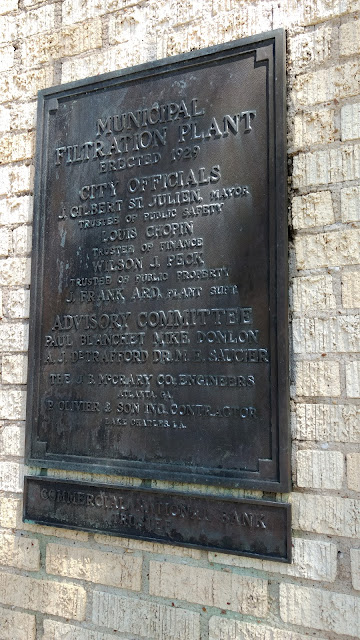
Municipal Filtration Plant, Erected 1929, City Officials J. Gilbert St. Julien, Mayor, Trustees of Public Safety, Louis Chopin, ...
Figure 3. Plaque on the North Water Treatment Plant showing that 
it was initially erected in 1929. 

In 1949, the City of Lafayette Board of Trustees adopted a bond resolution for $7,000,000 which funded improvements and extensions to the waterworks plant and the water distribution system, as well as other utility improvement for the electric power and the sewer systems. By October 1952, numerous improvements and extensions were completed or underway (LUS, 1953). The extent of the water system owned and operated by the Utilities System at that time is shown in Figure 4. This map shows the entire water distribution system, including extensions constructed under the bond improvement program.  About half of the water distribution network shown in Figure 4 was newly constructed under the 1949 bond improvement program.

Construction of a major plant expansion was started in September, 1952 . This plant extension added two open-type filters, one new Accelator clarifier (Figure 7) in an existing settling basin, and a new aerator. This expansion also included an extension of the main building to the north for chemical storage and feeding for lime (Figures 5 and 6). Water plant treatment capacity was expanded by 1.5 mgd (million gallons per day) which increased the total treatment capacity of the water plant to 4.5 mgd.

Figure 4. The Lafayette water distribution system in 1952 is mapped in this graphic (LUS, 1953). The water treatment plant is highlighted in red. A 500,000 gallon elevated water tank is to the right of the treatment plant in this map. Fire hydrants are mapped as black dots, 12" mains are mapped as heavier black lines, 4-10" mains are the finer black lines.

In the early 1950s, water supply for the City of Lafayette was obtained from a system of wells averaging 245 feet in depth in the Upper Sand of the Chicot Aquifer. Part of the wells were located on  the filtration plant grounds and part on a nearby separate lot at the intersection of Simcoe and Chestnut Streets (LUS, 1953, 1954). Table 1 shows the location of the five water wells operating in 1952. Wells #1 and #2 were abandoned during that year because of unspecified "difficulties," and a new well was planned at the Simcoe & Chestnut site.

Unit #
Location
1
Simcoe & Chestnut
2
Simcoe & Chestnut
3
Filtration Plant Grounds
4
Filtration Plant Grounds
5
Filtration Plant Grounds
Table 1. LUS water wells in 1952 (LUS, 1953).

The LUS Comprehensive Engineer's Reports (CERs) tell us that the system's water wells drew water from a sand and gravel strata which requires extensive screening at the base of the wells (LUS, 1953, 1954). Operation and maintenance of the wells and pumping equipment was reported to always be somewhat of a problem. It appears that wells loosing productive capacity as the wells aged continued. It was reported that the wells were treated with Calgon and HTH (calcium hypochlorite) on an experimental basis resulting in some increase of production. In 1954, wells were constructed fairly close together on the System's properties. However, it was planned that the next new wells might be built on separate property, some 2,000 feet from the treatment plant, where it was expected to have less influence from any of the other wells (this new site may have referred to the site of today's Clark Field and Hebert Golf Course). Water treatment plant expansion in the early 1950s (Figures 5-7) increased capacity from 3.0 million gallons per day (mgd) to 4.5 mgd (LUS, 1954). Difficulties with wells in the Chicot Aquifer Upper Sand, a desire to have higher production, and the recognized need to further separate the well intakes from surface contamination may all have been considerations that led to most of our present day wells being drilled deeper into the Chicot Aquifer Lower Sand.


Figure 5. This photo from the 1953 CER shows an expansion of the water treatment 
plant building which expanded the original 1929 plant building.


Figure 6. The expanded water filtration plant (LUS, 1954).


Figure 7. Clarifier constructed as a part of plant expansion (LUS, 1954).

Summary and Conclusions
The Chicot Aquifer has provided a plentiful source of water for millennia, and, if protected, will continue to provide for the water needs of future generations. The Lafayette municipal water system began in the late 1800's. By 1953, Lafayette's municipal water system had expanded to serve 9,247 households and businesses and supplied 825 million gallons of water annually (LUS, 1954). This is 2.26 million gallons per day, or about 240 gallons per customer per day. At that time all of this water was being pumped from the upper sand of the Chicot Aquifer from wells located near the water treatment plant on Buchanan Street at Mudd Avenue.

When the utility began operation at the end of the 19th century, the Chicot Aquifer was a freely flowing artesian water source. This pressure within the aquifer had been protective of the quality of the groundwater from surface contamination because any connections with the surface through springs (Chargois Springs for example), sand inclusions, cracks, abandoned wells, or flow through the confining clay layer itself would flow from the aquifer toward the surface. However, pressure in the Chicot Aquifer has been falling for a century (Borrok, 2016; Borrok and Broussard, 2016).

By 1954 the artesian spring no longer flowed, and pressure had diminished from positive to negative in the Chicot Aquifer. Any hydraulic connection of the aquifer to surface water became a conduit for flow into the aquifer transporting whatever contaminants were present at the surface into our underground drinking water source. Groundwater moves very slowly, often a few feet to a few hundred feet per year. Still, this reversal of groundwater flow direction which took place many decades ago sets the stage for destruction.  Recent observations of man made contaminates in Lafayette's drinking water wells (Waldon, 2017a, 2017b) serves to heighten citizens' concerns, and have led to a call for action (Waldon, 2017c).


REFERENCES

Borrok, David M. (2016) At Your Service: Keeping the Chicot Sustainable, Interview on KPLC TV News, Lake Charles, Published on Dec 21, 2016.

Borrok, David M., and Whitney P. Broussard III (2016) Long-term geochemical evaluation of the coastal Chicot aquifer system,Louisiana, USA. Journal of Hydrology 533:320-331.

Cheramie, David (2013) The Legacy of Native Acadiana. Acadiana Profile, August-September 2013.

Griffin, Harry Lewis (1959) The Attakapas Country: A History of Lafayette Parish, Louisiana. Pelican Publishing Company, Gretna, Louisiana,

Lafayette Advertiser (1897) Typhoid Fever and Water Supply. December 18, 1897, page 2.

Lafayette Advertiser (1999) New well. October 20, page 1

Lafayette Gazette (1895) Mr. Zell's visit. November 2, 1895, page 3.

Lafayette Gazette (1898) Water and Light: A model plant nearly completed - Everything works without a hitch. March 5, 1898, page 1.

Lafayette Gazette (1899) New artesian well. October 21, page 1.

LUS (1953) Comprehensive Engineering Report as of October 31, 1952. Prepared by R.W. Beck and Associates for the City of Lafayette Louisiana Utilities System.

LUS (1954) Comprehensive Engineering Report as of October 31, 1953. Prepared by R.W. Beck and Associates for the City of Lafayette Louisiana Utilities System.

Waldon, Michael G. (2017a) More Evidence of Chicot Aquifer Contamination: USGS Monitoring. ConnectorComments.org

Waldon, Michael G. (2017b) Contamination of our Chicot Aquifer.  What do we know? How do we know? What should be done? ConnectorComments.org

Waldon, Michael G. (2017c) Citizens seek action to protect our health, property, and drinking water supply. ConnectorComments.org

Zell, R.R. (1898) Report to the City Council on completion of the Waterworks and Electric Light Plant. Lafayette Gazette, April 16, 1898, page 1.