Showing posts with label Bypass Alternatives. Show all posts

Thursday, September 9, 2021

Another letter to the US Secretary of Transportation opposing the I-49 Connector


9th September 2021

The Honorable Pete Buttigieg

U.S. Department of Transportation 

1200 New Jersey Ave., SE 

Washington, DC 20590


RE: Opposition to the proposed Lafayette Louisiana I-49 Connector (1)


Dear Mr. Secretary:

Thank you for publicly recognizing the disproportionate impact of urban interstates on minority populations.  I was thrilled when you made the statement (2) that “In the Biden-Harris administration, we will make righting these wrongs an imperative.” This is a welcome change.

I am writing to you concerning the proposed Lafayette Louisiana I-49 Connector which is planning to plow 5.5 miles of new interstate through the heart of my city. I could use many adjectives to describe the proposed Lafayette I-49 Connector. A few are: unjust, wasteful, ill-conceived, high risk, anachronistic, and racist. I am asking you to use all of the power and influence of your office to either stop and deauthorize the Lafayette Connector project, or relocate the project’s corridor to the planned Lafayette bypass, the LRX (3)

In Lafayette, there has been articulate bi-partisan and multi-racial opposition to routing I-49 through our city center. Opposition has delayed this project for more than two decades. However, the lure of authorized federal project funds with a low level of local match has led to the expenditure of many tens (maybe hundreds) of millions of federal tax dollars for continuing plan revision within the central city corridor. 

Some among us believe that this project is a long-dead “zombie” surviving only on free federal planning and design dollars. Others fear that one day the project may actually move to a construction phase.  In either case, the specter of the so-called Connector has caused neighborhood property value to fall and neighborhood business to flee. 

The injustice and environmental risk of building along this urban corridor has long been recognized. In their scoping comment on the 1998 DEIS, the USEPA Region 6 pointed out the requirement of Executive Order 12898-Federal Actions to Address Environmental Justice in Minority Populations and Low-Income Populations. They stated that Federal agencies are ordered to analyze (4)

 "the environmental effects, including human health, economic and social effects, of federal actions"

Despite many millions of tax dollars spent over more than two decades, these federal requirements identified by EPA in 1998 have never been seriously addressed. I believe that this is because there is no answer. The selected routing of the project corridor was unjust by design. 


Thank you for your consideration of my request.


Sincerely,

Michael G. Waldon


Footnotes:

  1. Louisiana State Project No. H.004273
  2. Twitter @PeteButtigieg Dec 20, 2020
  3. Lafayette Regional eXpressway,  http://www.lrxpressway.com/
  4. Final Environmental Impact Statement, I-49 Connector, Lafayette Louisiana, August 2002, Volume 2, Appendix C, Page C-29


This letter is also available in pdf format through this link.

Friday, March 15, 2019

February 2019 LRX Public Meeting Comments

The comments below were submitted on March 15, 2019. The February public meeting that solicited these comments presented the Tier 1 Environmental Impact Study for the Lafayette western bypass termed the Lafayette Regional Xpressway or simply the LRX. Learn more about the meeting and the LRX by reading the recent Connector Comments meeting announcement. It is available by clicking HERE.

The period for public comments closes on March 18, so you may still have time to submit your statement of support, concerns, or questions. Although the attached comment is quite detailed, short comments simply stating support and/or concerns are of great value and provide evidence of public interest.

The meeting slide show included this information on how to provide written comments after the meeting:
  • Send comments to: HNTB Corporation,10000 Perkins Rowe, Suite 604, Baton Rouge LA 70810,
  • or, Email comments to kbprejean@hntb.com
  • Comments received or postmarked by March 18, 2019 will become a part of the record.

If you have submitted or do submit comments through one of these methods, please consider sharing your comments with us by pasting then in the comments section at the end of this article. However, do be aware that comments on this Connector Comments site are not official, so be sure to submit official comments as described in the bullets above.


__________________________________________________________

Comments of Michael G. Waldon, PhD
Following LRX Public Meeting February 28, 2019


The following comments are my comments submitted in response to the request for public comments at the Public Hearing held in Lafayette on February 28, 2019.
I have divided my comments into the following topic-related sections.

Statement of appreciation
Relationship to other projects and needed model scenarios
Where is the Eastern Corridor?
Arkansas example - phased funding and completion
Flooding
Preferred corridor selection
Public information and participation
Public support
2005 Study Corridor Map


Statement of appreciation

I first sincerely thank the LMEC for holding this hearing and giving the public an opportunity to share our support and concerns. Thanks is also due to the visionary citizens of Lafayette who saw almost two decades ago that the only viable path forward for a north-south interstate connecting I-49 segments was a bypass. At that time, the so-called I-49 Connector, the “Con,” was seen to be effectively dead; killed by fierce public opposition, environmental infeasibility, and legal challenges. And rightfully so.


Relationship to other projects and needed model scenarios

If we cannot call the LRX an alternative to the I-49 Con, then at least allow us to call it a substitute.

Although our Louisiana DOTD continues to waste many tens of millions of federal tax dollars on planning the I-49 Con, it is even less viable today than in the early 2000s when it was effectively abandoned. Today’s advancements in geochemical science provide an even better understanding of the environmental risk of further contamination of the Chicot aquifer, and there is a renewed concern for flooding since the 2016 regional flood disaster. Additionally, the massive negative impact of urban interstates, particularly on poor and minority communities has become even more apparent than it was  decades ago. The Con is today quite simply inviable (i.e. dead). For years the LRX plans were stalled in order to not “distract” the public with the promise of a substitute for the locally opposed Con. Let us delay no longer. The LRX is our most advanced proposed substitute for the failed Con, and I urge our professional, political, and civic leaders to now give its development their enthusiastic support. Lafayette does urgently need the LRX project. Although completion of the LRX may be far in the future, every distraction coming from the Con, and every other delay simply moves LRX completion further into that future.

If ever built, the I-49 Con is almost certain to be partially toll funded (https://connectorcomments.blogspot.com/2016/06/the-specter-of-tolls-on-i-49-connector.html). Former Secretary of Transportation Dr. Kam Movassaghi was quoted (The Independent, April 14, 2009) saying that tolls must be considered for funding I-49 construction. An expert speaking to a meeting sponsored by our Chamber of Commerce affiliate One Acadiana (The Advocate, October 22, 2015) suggested that a toll of $0.19 per mile might be used to fund I-49 completion, and an Advocate article (September 22, 2014) reported that a state funded feasibility study looked at $0.18 per mile for I-49 funding. Former State Senator and then I-49 South Coalition Director, Mike Michot, was quoted in that same article saying about I-49 South "It seems unlikely a project of that magnitude will be built without the help of toll dollars."

The infeasibility of building the I-49 Con project is highly relevant in planning for the LRX, as is the prospect of the Con also having tolls. Additional model scenarios need to be considered for LRX planning. First, the scenario that the I-49 Con will never be constructed needs to be considered as a scenario because this is in fact most likely. Second, the scenario that the I-49 Con is built but has tolls must be considered. Adding tolls to the I-49 Con in modeling will increase traffic flow and toll revenue of the LRX. Failure to include these added scenarios related to the future I-49 Con seriously impairs planning for LRX traffic and toll revenue. Failure to consider these scenarios could negatively impact Louisiana's financial negotiations in dealing with the private PPP project partner for the LRX. 

It seems relevant to mention here that despite the tens of millions of dollars already spent on I-49 Con planning, to-date the DOTD has refused to include an I-49  toll scenario, or to incorporate the LRX in any I-49 Con traffic models. To members of the public this appears to be a blatant attempt to inflate traffic projection to thus justify the Con project. This concern is relevant here because I hope that such manipulation of planning results is not a part of the LRX project. A refusal to run the added scenarios listed here would lead to a similar but opposite appearance. It would lead the public to think that the LMEC and DOTD are purposefully failing to consider scenarios in order to “put their finger on the scale” giving preference to the Con relative to the LRX substitute.

In summary of my concerns stated in this section, I am asking that two LRX planning scenarios (model runs) be added for projection of traffic and toll revenue. First, projections are needed for the most likely future in which the I-49 Con project is abandoned and never built. Second, The scenario that the I-49 Con is constructed as a toll funded project is additionally required. Planning for the LRX that does not consider these possible futures would have little credibility in the eyes of the public. 

Where is the Eastern Corridor?

Earlier LMEC documents map an eastern corridor extending from I-49 north of Carencro to I-10 west of Breaux Bridge. Documents include “TECHNICAL MEMORANDUM 4: ENVIRONMENTAL RECONNAISSANCE” dated February 2005, “LAFAYETTE METROPOLITAN EXPRESSWAY FEASIBILITY STUDY EXECUTIVE SUMMARY IMPLEMENTATION PLAN”  dated June 2005. Figure 4-1, “Study Corridor Map,” from the 2005 Technical Memorandum 4 is appended to the end of these comments for the reader’s convenience. I have seen no published planning or engineering study, or any rationale for dropping the eastern segment. Was a decision made to drop this option? Does any documentation of the decision exist and was the public invited to comment on the decision?

For many years local citizens have supported an eastern route bypassing Lafayette following the high ground of the Teche Ridge. Here are a few of the links demonstrating this long-term support information on this proposed roadway:
     Kelly Roberts Caldwell spokesperson comments for Lafayette citizen groups in the I-49 Connector FEIS, Volume II, page 299  dated April 30, 2001 https://connectorcomments.blogspot.com/2017/04/public-comment-from-16-years-ago.html
     Connector Comments blog, May 27, 2016, “The I-49 Lafayette Bypass Option: Teche Ridge” https://connectorcomments.blogspot.com/2016/05/the-i-49-lafayette-bypass-option-teche.html
     I-49 Teche Ridge Bypass Facebook page https://www.facebook.com/I-49-Teche-Ridge-Bypass-191859984503529/
     Harold Schoeffler’s presentation to the St. Martin Parish Council on February 16, 2016 https://soundcloud.com/mike-waldon-906517104/hschoeffler-stmartinparish-2016-02-16

Some have suggested that such a roadway might begin as a two lane expressway and expand where needed to four lanes. Combined tith the LRX, the Teche Ridge eastern bypass would provide Lafayette with a full loop. This would improve traffic, efficiency of travel, and attract desirable economic development to communities in both Lafayette and St. Martin Parishes.

This comment is directly relevant to the LRX plan because it appears that the proposed eastern corridor was aligned to connect with the eastern Teche Ridge bypass which has been so long supported by citizens here. While I understand that the LMEC desires, as far as possible, to keep roadway development within Lafayette Parish, it seems arbitrary and wasteful to drop the eastern corridor from all consideration. I ask that future planning include this eastern corridor as a potential future extension. 

Arkansas example - phased funding and completion

The Bella Vista Bypass (Arkansas Hwy 549) is being constructed in Arkansas as a part of their I-49 completion. I believe this is a good example of a state (Arkansas) listening to public concerns and developing a bypass rather than running the interstate through the heart of a community. The Bella Vista bypass has been designed and is being and constructed by ARDOT. It is being constructed one segment at a time as funding becomes available. While in Lafayette we are mired in I-49 planning that will likely never lead construction, Arkansas is building a highway. The Bella Vista Bypass is initially being constructed as a two-lane expressway which will be expanded to four lanes as funding permits. Arkansas has been able to design a viable project which will likely be completed long before we even begin construction. I urge the LMEC and Louisiana DOTD to consider using a similar incremental approach for the LRX. You can learn more about the Bella Vista Bypass from the Wikipedia article titled “Arkansas Highway 549,” by Googling news articles, and by downloading ARDOT project documents.

Flooding

In an urban setting such as the I-49 Con, finding hundreds of acres outside the flood zone for runoff retention is at-best expensive and at-worst impossible. However, in the rural setting of the LRX this is less of a problem and may actually be viewed as a project benefit. I urge the LMEC to make flood impacts from the LRX project an integrated part of planning. In other projects the Louisiana DOTD has been accused of failing to adequately consider flood impacts of their projects. My understanding is that, as a state agency, DOTD is not required to follow local ordinances requiring runoff retention or other flood impact analyses or mitigations. In spite of this I ask that the LMEC pledge to integrate runoff management planning into every level of LRX design including the plan development for roadway routing. In the rural setting of much of the LRX, retention ponds can actually be an aesthetic feature while possibly providing needed fill for roadway elevation. Landowners may also welcome retention ponds as neighboring features which improve property values and provide alternative drainage for development.  

Preferred corridor selection

I agree with the selection of the preferred corridor identified in the meeting handout. Not only does this selection best meet the criteria in the selection matrix, It is the alternative which may most quickly be constructed.

Public information and participation

At the public hearing I voiced my concern that the LRX web site (www.lrxpressway.com), was not being maintained, and information on the site appeared to be years out-of-date. I also noted that information from the 2017 public hearing had not been posted to the site as had been promised to me at that meeting. Following the 2017 meeting, I did try on multiple occasions to contact anyone from the LMEC about this, but was unable to do so using the outdated information then available on the web site. If I had expended more effort I could have likely made contact, but such a level of effort should not be required for a member of the public to simply get information.

I have additionally tried to find the schedule for the quarterly LMEC meetings, meeting agendas, and meeting minutes. As a public body in Louisiana, there are requirements that these be available on the web site. However, such information was not on the LRX web site. Following the February public meeting, I was told that some of this information is actually on the LEDA web site. However, I have not found this information on either the LEDA web site or the LRX site. The LRX website has an LMEC meeting page which is reached from a link on the “about LMEC” page:  www.lrxpressway.com/lmec-meetings/
However this page refers to the schedule of the 2011 meetings, and even that information is incomplete.

Please post on the LRX website all documents required by law and publish timely announcements of the quarterly LMEC meetings. At a minimum LMEC must meet the requirements of the Louisiana open meeting law, but I hope LMEC will exceed these requirements by actively seeking public involvement.

Since the February 2019 meeting, I do see that LRX public meeting materials have been added to the LRX web site for 2019, and prior public meetings including the 2017 public meeting. These posted documents have been useful and I thank the LMEC for providing them. However, I am unable to locate agendas, calendars, or minutes for the legally required quarterly meetings of the LMEC. I request that these either be provided on the LRX site, or that a link be placed on the LRX web site to wherever these documents are archived. I also ask that LMEC meeting announcements be prominently posted on the LRX website along with the agendas for upcoming meetings so that the public and media may attend.

Public support

There was a clear demonstration of the public’s interest in the LRX project shown by the standing-room only crowd at the February public hearing. Although I did hear mild concern from a few potentially impacted property owners, I did not hear a single person comment that they were opposed to this project. This stands in stark contrast to the near unanimous public opposition concerning the I-49 Con voiced at every public meeting held over more than two decades by DOTD and others. The public is not timid in voicing opposition, and I felt that the lack of any expression of opposition toward the LRX, as well as the many positive voices of strong support, together give an indication that the LRX project can be successful. The LRX can be a valuable addition to our region’s transportation infrastructure. I support its development. Thank you again for this opportunity to comment. 


2005 Study Corridor Map
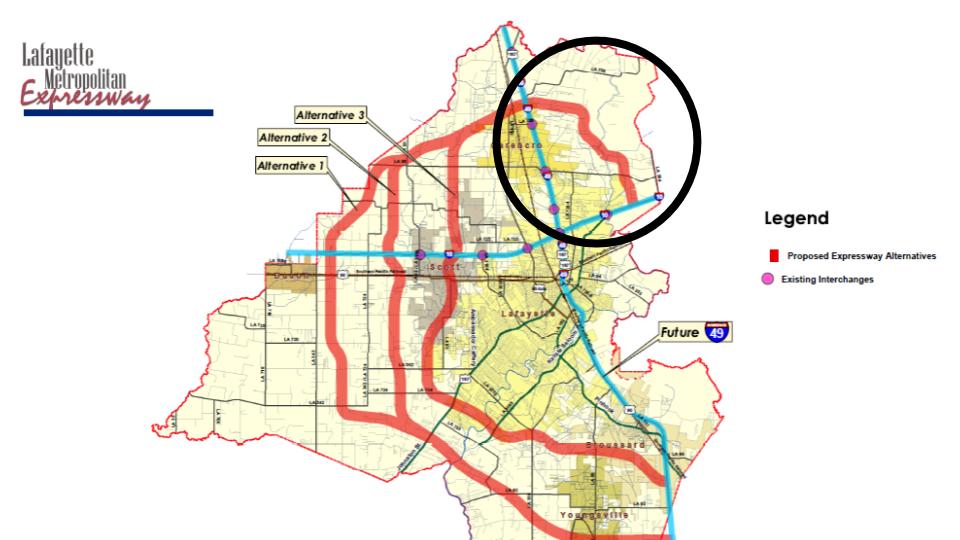


February 2005 “Study Corridor Map” from Figure 4-1 in the report “Lafayette Metropolitan Expressway, Technical Memorandum 4, Environmental Reconnaissance.” The black circle was added to the figure to indicate the segment termed the eastern corridor in these comments.


Michael G. Waldon, PhD
Resident of Lafayette Parish, Louisiana

March 15, 2019

Tuesday, February 26, 2019

Louisiana wants your opinion on a Lafayette Interstate 49 bypass, the LRX

Thursday, February 28, 2019, at the Lafayette Parish South Regional Library, the State of Louisiana will host a public hearing on their plans to build a western bypass around the City of Lafayette. The meeting will continue from 5:30 to until 7:30 pm.
Meeting Agenda:
  • 5:30-6:00 pm -View exhibits and speak with the project team
  • 6:00-6:15 pm - formal presentation
  • 6:45-7:30 - public invited to provide comments in a moderated and recorded forum
The host agency for the meeting is the Lafayette Metropolitan Expressway Commission or LMEC. Beginning almost twenty years ago, efforts and support of Lafayette civic leaders led to the creation of the LMEC by our Louisiana Legislature in 2003. The LMEC provides oversight for construction planning and financial planning for a proposed Lafayette limited access interstate bypass. They call their proposed bypass the LRX or Lafayette Regional Xpressway.
After years of work, plans have progressed, and the LMEC is seeking your comments on their Tier 1 Draft Environmental Impact Statement (EIS) which evaluates potential alternative highway corridors. The plan is for the LRX to be partially funded by tolls as part of a public-private partnership (PPP). As such, this project might be funded and built long before the costly I-49 connector (I-49 Con) project moves a shovel of dirt.  
The state will not say that the LRX is an alternative to the widely-opposed and costly I-49 Connector. I assume this is necessary to avoid loosing federal planning funds. However, the choice is clear - the LRX eliminates the reasons for building the I-49 Connector. If it is not an alternative then let's call it a substitute. If well managed and designed, the LRX substitute is financially a better deal for taxpayers. The LRX should have little or no flood impact, unlike the I-49 Con it will not cross a massive abandoned toxic site or impact our drinking water, and it will reduce traffic congestion in the city while giving rural residents new travel options. 
You can learn more about the LRX plan through the LMEC website http://www.lrxpressway.com/Their meeting announcement is available by clicking HERE.
DevelopingLafayette.com published an excellent article titled "Lafayette Metro Expressway “Lafayette Loop” Planning Continues.". And Claire Taylor published an article in The Advocate titled "Public can weigh in on Lafayette toll loop during Feb. 28 meeting." Click on the titles to read these articles.
Your comments to the LMEC and state DOTD will be accepted at the meeting. If you are unable to attend, or just want to give additional comments, you can submit your comments via their Web site (www.lrxpressway.com), or by U.S. mail to LRX Project Team, HNTB Corporation, 10000 Perkins Rowe, Ste. 640, Baton Rouge, LA 70810. Any written comments received by or postmarked on or before March 11, 2019 or 45 days following publication of the Notice of Availability in the Federal Register, whichever is later, will become a part of the record.
After the February 28 meeting I will publish an article here in Connector Comments detailing new LRX developments and comments I hear from other participants. 
I urge you to support the LRX and help save our city and parish from the disaster that is the I-49 Con.  
Alternative LRX corridor map from 2017 public meeting.

Tuesday, October 23, 2018

The I-49 Boondoggles

What is a BOONDOGGLE? Wikipedia tells us it refers to
projects involving large numbers of people and usually heavy expenditure, where at some point, the key operators, having realized that the project will never work, are still reluctant to bring this to the attention of their superiors.  
Public opposition to routing I-49 through the heart of our city goes back at least to 1992, and for years now, Lafayette residents have recognized that the government project now being called the Lafayette I-49 Connector (we call it the I-49 Con) is a prime example of a wasteful government boondoggle (for an example of public comment read "Why the I-49 connector won't work" published May 27, 2016 in the Daily Advertiser). The public has been assured many times that if there is significant public opposition to the project it will never be built. Yet, the I-49 Con continues spending tens of millions of tax dollars on studies and design that will never be used for a footprint through the heart of the Lafayette.

Sarah Palin holding Nowhere Alaska t-shirt
Sarah Palin holding a T-shirt related to the Gravina Island Bridge.
Credit: Bob Weinstein via Wikimedia
Regardless of how wasteful the project, politicians from both sides of the aisle often find it hard to oppose tax funded boondoggles. Perhaps this is because of the inevitable cycling back of a percentage of the money into campaign contributions. Even some of the most conservative politicians seem unable to pass up wasteful government boondoggle projects. Do you recall the support of Sarah Palin for federal funding of the Gravina Island Bridge commonly referred to as the iconic "Bridge to Nowhere?"


The national Public Interest Research Group (USPIRG) published their 2018 list of US interstate highway boondoggle projects. If built as proposed, these boondoggles would waste tens of billions of our federal transportation tax dollars. And, even if these boondoggles are never built, billions will be spent on their planning and design before public pressure and simple rationality end their useless authorizations.

Although our own local boondoggle, the I-49 Con, did not make the USPIRG list this year, its sister project in Shreveport, the Shreveport I-49 Inner City Connection did make 2018's national list of worst boondoggles. Better luck next year to our own I-49 Con! If USPIRG accepts nominations in 2019 the I-49 Con will have my vote.

It is important that our political representatives hear from their voters about stopping these federal transportation boondoggles. If we don't speak up the only voices our leaders hear come from paid lobbyists representing the corporations and contractors who are hoping to continue getting design and construction contracts.

We do know that at least some of our leaders are hearing us. On October 17, 2018, One Acadiana hosted a 3rd Congressional District Candidate Forum. All seven remaining congressional candidates running in the November 6 general election participated in the forum:


Several of the candidates spoke to the forum in general terms about our need for improved infrastructure and the need to eliminate wasteful federal spending. However, two candidates spoke directly about problems with routing I-49 through the center of Lafayette. Congressman Clay Higgins noted that routing the interstate footprint through the central city would displace or impact a large number of private property owners. He concluded that an actual footprint for the project still needs to be selected. Candidate Mimi Methvin cited further problems with the central city route including its planned passage through the highly contaminated former railyard site. Furthermore, she noted that today urban experts and planners recognize urban blight in many US cities has been caused by the past construction of inner-city interstates.

Do you agree that the Lafayette I-49 Con is one more federal boondoggle currently wasting many tens of millions of tax dollars on design of a route through the heart of our city? Do you agree that, as now planned, the I-49 Con should never and likely will never be built?

If your answer is yes, I urge you to contact your chosen 3rd district candidate. Tell him/her of your opposition to the currently proposed central I-49 route. Ask your candidate to support planning for one of the much less costly and less damaging alternatives bypassing Lafayette to the east along the Teche Ridge or west following the plan for the Lafayette Regional eXpressway (LRX). In addition to saving federal and state taxes, either alternative also involves much lower cost to our local governments, reduces risks to property and health, and eliminates most impacts to flooding and traffic congestion inherent in the I-49 Con planned route through the heart our city.

Mike Waldon, PhD
October 23, 2018 

Monday, June 12, 2017

Please comment on plans for the LRX: Interstate bypass alternatives


Several past posts on this blog, ConnectorComments.org, have dealt with Lafayette bypass alternatives that would compete with the proposed I-49 Connector which proposes to build an elevated urban interstate through the heart of Lafayette. Lafayette bypasses would compete with the I-49 Con for projected traffic load, and therefore funding and priority.

Last week, June 6th and 7th, the Lafayette Metropolitan Expressway Commission (LMEC) hosted open house meetings which updated information on their plans to build the Lafayette Regional Xpressway (LRX) as a partially toll-funded interstate bypass west of Lafayette.
The LRX bypass will allow through traffic to avoid passing through Lafayette's urban core, and should relieve the city of much of its heavy truck and hazardous cargo traffic. It would also draw traffic away from some of the heaviest traffic areas of the Parish.

The infrastructure solutions firm, HNTB, gave one-on-one presentations to the public during the LMEC open house. We were told that meeting materials would be posted on the LMEC web site after the meetings. That information is not yet posted, but I have scanned the meeting handouts which are available through these links:


Public comment on LRX planning has now been requested as a part of the project's Tier 1 Environmental Impact Statement (EIS). Completion of this EIS is anticipated at the end of this year. I urge all readers of this blog to comment, share, and ask friends to submit comments. Although our state and local politicians have financial and legal constraints that limit describing the LRX as an alternative to the I-49 Con, the obvious fact  is that both would be competing parallel roadways, and funding completion of either makes it unlikely the other will ever be built! These projects are in a competition for priority and funds. Now it is up to the public to declare their preference.
The third document, the questionnaire and comment form, should be submitted to the email or postal address given at the bottom of the form. There is no set deadline for submitting public comment, but I believe it would be best to send in your comments within the next 2 weeks, and certainly by the end of June. Emailed comments should be sent to kbprejean@hntb.com


Wednesday, June 7, 2017

LRX June 2017 Open House Handouts

Last night, June 6, 2017, I attended the LRX open house public meeting at the East Regional Library in Youngsville. This evening from 5:30 to 7:30 there is a second meeting with the same format and materials being held at the  Scott City Hall, 109 Lions Club Road, Scott. This very short post is written to give tonight's attendees a heads up about what to expect, and also gives everyone not attending a bit of information.

See my Google Drive folder for this
and other handouts.
The open house format of the meeting means you may expect to take 20 minutes to an hour looking at posters and speaking one-on-one with staff from HNTB about the project that they are contracted to lead. I learned that they are doing the EIS (Environmental Impact Statement) for the project in "tiers." They plan to complete the Tier 1 EIS in December.

There were 3 handouts provided at the meeting

  1. A double sided sheet with general information
  2. An LRX Project Area and Corridor Alternatives map
  3. A comment sheet and questionnaire
The questionnaire/comment sheet can be turned in at the meeting, or sent later by mail or email. I plan to scan and email mine so that I keep a copy for my records. You can download copies of the handouts from my Google Drive folder.

No deadline was given for submitting comments, but I assume they should be sent expeditiously. 

Finally, they stated that all meeting materials would be available on their web page, Lafayette Metropolitan Expressway Commission, after the second meeting.


Tuesday, June 6, 2017

Public meetings announced on the LRX: An alternative to the I-49 Connector?

http://www.lrxpressway.com/
The Lafayette Regional Xpressway, LRX, is a western interstate bypass planned to go west of Lafayette. The Lafayette Metropolitan Expressway Commission has invited you to two Public Meetings with the same open-house meeting format in two locations:


The Daily Journal of Commerce, Louisiana and Mississippi reported on July 5 last year that "it's been roughly five years since any significant public discussion of the project" and "the commission had paused planning for the bypass so as not to compete for attention with the proposed Interstate 49 Connector (emphasis added)." Work and appropriations for the LRX have been continuing, however. In January 2016 an agency meeting reported progress on the EIS and tentative selection of a preferred alternative route. 

Finally after this long delay, the public will be allowed to see what secret progress has been made over the years on this alternative routing for I-49! As always, DOTD will tell us again that "this is not an alternative I-49 route," but I think it is abundantly clear that only one, if any, of these interstate projects will be funded over the next 50 years. 


Wednesday, April 26, 2017

Public comment from 16 years ago documents our citizens' struggle against the I-49 Con


Click on letter to enlarge.
The following comment by Kelly Roberts Caldwell dated April 30, 2001 was included in the FEIS, Volume II, page 299.  

Today, citizens continue to "battle a proposal that is, on its face, senseless." Now the senseless plan is called the I-49 Con.  


Secretary Kam Movassaghi
Department of Transportation & Development
P.O. Box 94245
Baton Rouge, LA 70804
Dear Sir:

The citizens of Lafayette fully support the extension of I-49 South. We strongly support a
Lafayette eastern bypass and are deeply opposed to an elevated interstate thru the heart of
our city. In July, 1992, a public meeting was held after an EIS was distributed of the Evangeline
Thruway corridor plan. Citizens voiced overwhelming opposition resulting in its withdrawal. In
1997, the project was restarted by DOTD at the urging of the chamber of Commerce leadership
who have relentlessly pursued the Evangeline Thruway placement. New strategy! Lead the
public to believe that other alternatives are being considered. Many reasonably assumed that the
1992 official public rejection eliminated Evangeline Thruway. Wrong! Residents realized very
late thai the "alternatives" were all simply "variations" of the previously rejected Thruway plan.

I am a spokesperson for a campaign by The Sierra Club, Citizens Speak Out, Sterling Grove
Historic Association, Tree Society of Acadiana, Annabelle Subdivision Association, and others
joined to promote an I-49 eastern bypass. Our petition has over 1000 signatures with more added
each day. Lafayette citizens arc now at risk from the 50,000 vehicles per day on Evangeline
Thruway, many hauling hazardous materials. Why plan to increase the risk with 100,000 daily
estimated for completed I-49? Proponents insist an eastern bypass was studied and rejected.
Rejected by whom? Where are the studies? Why choose this destruction and danger to our
community? ls it simply a price the local power structure is willing to pay to keep the project all
within Lafayette Parish - avoid sharing with our neighbor, St. Martin?

We are told a Lafayette eastern bypass would impact wetlands (though their plan requires moving
a runway at our airport into wetlands). Harold Schoeffler, a well known businessman and
environmentalist and Pierce Meleton, respected architect, and others actually mapped out a route
to the east between Breaux Bridge and Lafayette into St. Martin. It runs beyond Cypress Island
Swamp but west of the beautiful Teche thru sugar cane fields and pasture land coming back into
90 below Broussard. Destroys no homes or businesses. Gives St. Martin needed interstate
access and avoids the adverse impacts in Lafayette. Be vastly superior for evacuation- with two
highways out rather than the one sure to become an elevated trap in Lafayette. When taken to
highway engineers cost estimates were about half that of cutting thru lafayette. Likely you were
sent the St. Martin resolution asking that the Teche Ridge alternative be considered.

Citizens must battle to save themselves from a proposal that is, on its face, senseless? Impacts
to the human and natural environment so enormous that governments' talk of "mitigation" is a
joke in the community. An elevated federal interstate alongside a national historic district?
Elderly, poor and minorities disproportionately impacted? Their sector of the city walled of!?
Please do what you can.

Kelly Roberts Caldwell

Friday, May 27, 2016

The I-49 Lafayette Bypass Option: Teche Ridge

Google Earth image showing the approximate path of the
proposed Teche Ridge bypass.

For nearly two decades, Acadiana residents and taxpayers have urged DOTD to consider an I-49 bypass option following the Teche Ridge in St. Martin Parish. This roadway would follow along the natural ridge that follows west of Bayou Teche. This area has few wetlands, does not flood, and is primarily in agricultural use. An engineering feasibility study, funded in part by the St. Martin Police Jury, was completed by the engineering firm T Baker Smith.

And, as taxpayers the difference in estimated cost is staggering. The 5.5 mile I-49 Connector (Divider) is estimated to cost over $1 billion, while the 20 mile Teche Ridge route would cost far less than one third of that total. This is over $200 million per mile for the Connector before costs of toxic waste cleanup and flood control are even considered. The 20 mile Teche Ridge route would cost a more conventional $15 million per mile.

The Teche Ridge route would obviate extending the Lafayette Regional Airport runway into the Cypress Island Swamp, avoid issues of diminished airport safety, obviate wetland loss from fill, and obviate induced flooding associated with the airport revisions. It also greatly improves resilience of hurricane evacuation for the large population living south of Lafayette.

Furthermore, the Teche Ridge route could be a part of a larger project to provide a bypass loop around our urban core. Combining the Teche Ridge route with the western Lafayette Regional Xpressway (LRX) would give Lafayette a full urban interstate loop. Now, note that this 80 mile loop would cost approximately the same as the 5.5 urban Divider being forced on our taxpayers and neighborhoods.


For more information on the Teche Ridge, check out these resources:

Teche Ridge Bypass Facebook page
  https://www.facebook.com/I-49-Teche-Ridge-Bypass-191859984503529/

Presentation by Harold Schoeffler to the St. Martin Parish Police Jury
 https://www.facebook.com/michael.waldon/posts/10204527887710661

Teche News article on the Teche Ridge Highway alternative.

The Daily Iberian, February 17, 2016, Teche Ridge I-49 proposal gets traction in St. Martin


Wednesday, May 25, 2016

The I-49 Lafayette Western Bypass Option: The "Lafayette Regional Xpressway"

One bypass alternative for Lafayette has been under study by the DOTD since 2003. At that time, the Lafayette Metropolitan Expressway Commission was created by the Louisiana State Legislature. They are commissioned to study alternatives for the Lafayette Regional Xpressway, or simply the LRX. The LRX would create a bypass loop which begins in the south at Highway 90 / I-49 south of Broussard, has a major interchanges as it crosses Highway 167 (Johnston Street) north of Abbeville, and I-10 between Duson and Scott. This portion of the roadway would be very roughly 25 miles. The bypass would then continue north and east for roughly 20 miles to return to I-49 north of Carencro. An eastern bypass leg of very roughly 15 miles would run south east from north of Carencro to I-10 west of Breaux Bridge. Total length of the Lafayette Regional Xpressway bypass would then be very roughly 60 miles.

 The Lafayette Metropolitan Expressway 2005 feasibility study’s rendering of a proposed expressway. (Photo: Lafayette Metropolitan Expressway)


At an estimated cost of $760 million, the cost per mile for this roadway is under $13 million per Interstate mile. The 5.5 mile Lafayette Connector project which now has cost estimates of over $1 billion before toxic waste removal and flood mitigation have even been considered. This gives the Connector a cost that will greatly exceed $182 million per mile. 


More information is available at

Lafayette Regional Xpressway Project Website  http://www.lrxpressway.com/

The Advertiser, October 23, 2015,  Citigroup and the Lafayette Loop — what's next?
 http://www.theadvertiser.com/story/news/2015/10/22/citigroup-and-lafayette-loop/74359164/

The Advertiser, October 23, 2015,  Is Lafayette ready for a traffic loop?
 http://www.theadvertiser.com/story/news/2015/07/01/still-loop/29588975/

Lafayette Regional Expressway Rendering
Source: http://www.lrxpressway.com/