Showing posts with label Public comments. Show all posts

Tuesday, January 24, 2023

I-49 Connector Civil Right Violation Complaint Accepted for Investigation

FWHA Civil Rights Title VI

Connector Comments readers may recall that in November 2021 Lafayette resident Ann Burruss wrote a letter to Secretary Pete Buttigieg opposing the plan for the Lafayette I-49 Connector. A staff member assigned to respond to her letter told Ann that her letter appeared to be a civil rights complaint. With Ann's consent, her letter was then processed as a complaint. Ann followed up on this complaint providing evidence that the Connector's corridor was indeed selected to follow the historic line of racial segregation in our city. With Ann's permission, her letter submitting this evidence is reprinted below. 

On January 18, 2023, Ann received a letter via email saying "that the FHWA Office of Civil Rights has accepted for investigation your complaint of discrimination." The investigation will focus on "Whether the Lafayette I-49 Connector Project creates potential disparate, adverse impacts to residents based on race, color, or national origin." Readers may wish to send their own letters supporting this complaint or providing additional evidence. Comments or supplemental evidence should reference complaint number DOT# 2022-0093 and should be submitted to:

Erik Lacayo
Title VI Program Analyst
Federal Highway Administration
Office of Civil Rights
(202) 913-3926
erik.lacayo@dot.gov

If you do send a comment or document, please let us know about it in the comments section at the bottom of this article. 


________________________________________


Federal Highway Administration                                    March 31, 2022
Office of Civil Rights (Attention: Erik Lacayo)
1200 New Jersey Ave., SE
Washington, DC 20590

Reference: HCR-20
DOT# 2022-0093

Subject: Complaint #2022-0093

Mr. Lacayo,
Enclosed are documents that I hope you will find useful.
  • Ordinance No. 127, City of Lafayette Louisiana, enacted October 22, 1923, 4 pages
  • 1928 Sanborn Fire Map close up, 1923 segregation areas in blue
  • 1928 Sanborn Fire Map reference
  • 1928 Sanborn Fire Map blow up, segregation areas in blue (can piece together and tape) 8 pages
  • I-49 Connector Alignment, overview
  • I-49 Connector Alignment folded map, streets in 1923 segregation area identified for cross reference
  • 1928 Sanborn Fire Map folded map, 1923 segregation area in orange, I-49 Connector alignment in pink

Again, I thank you and the department for investigating the I-49 Connector project for Civil Rights violations. To me, who has very little idea of how a Civil Rights violation is determined, the documents are a clear illustration that the 1-49 project as proposed is inherently unjust and in violation.

If there is any additional information I can provide, I will do my best. At this point this is what I have regarding the racially unjust impacts of the project. The path of this project follows a clearly defined racial segregation line from the past. Establishing that line in 1923 was all that was needed to etch in stone an economic and racial divide that exists in this city on these streets to this day. The ordinance was subsequently repealed because, I've been told, that white people lived within the zones designated as "negro communities" and did not want to move. Of course subsequent jurisprudence and federal law disallowed such ordinances, however, the damage was done. If this project is built through the center of our city this racist past will carry its racist impacts into our future.

Sincerely,

Ann Burruss

Tuesday, November 30, 2021

Secretary Pete: Put an immediate stop to the I-49 Lafayette Connector

Lafayette resident Ann Burruss sent the following letter to Secretary of Transportation Pete Buttigieg with copies to our Louisiana Governor, Lafayette Mayor, and Louisiana Transportation Secretary. The photos in this letter were taken by Ann earlier this month at the DOTD I-49 Open House poster presentation. 

If you feel strongly about the Lafayette I-49 Connector, you too can voice your opinion to the U.S. Secretary of Transportation by sending a letter to: The Honorable Pete Buttigieg, U.S. Department of Transportation, 1200 New Jersey Ave., SE, Washington, DC 20590. You may also email the secretary at  DOTExecSec@dot.gov.


____________________________________________________

Louisiana State Project No:  H.004273.5
Federal Aid Project No.:   H004273
Secretary Buttigieg, November 17, 2021

Congratulations to you and to the Biden administration for passing the infrastructure bill. In my volunteer work for Second Harvest Food Bank in Louisiana, I drive on substandard roads in rural parishes and I know what this bill can mean for struggling workers who commute on bad roads and bridges. Thank you for putting the needs of working people first.

I am writing today to ask that you put an immediate stop to the federal highway project called the I-49 Lafayette Connector in Louisiana. While promoting the infrastructure bill the administration talks about racial justice and equity as driving factors in projects.  Extending I-49 through the center of the city of Lafayette, Louisiana, is the exact opposite of that goal.  The planned route replaces a surface road with an elevated interstate. It’s like the 1960s and 70s all over again! As if we have learned nothing about the damage -- the permanent dismemberment -- that an interstate highway does to a city.  The I-49 Connector is racially unjust. It cements a redline through our city. It divides historically black communities from the prosperous downtown. We know better than we did in the 60s and 70s. We must do better.

The Louisiana Department of Transportation and their consultants held a series of sparsely attended open houses here recently.  They never ask the public ‘Do you want this interstate?  Do you need this interstate? If you need an interstate, where do you want it routed?’  It's always, ‘Do you like this lighting feature or that lighting feature? Do you want your children to be able to bike under this fabulous interstate, or do you want them to play basketball?’ I say “Neither.”

I and many informed citizens want this interstate to Not Be Built Here.  Instead, we want to see the LRX (Lafayette Regional Xpressway) built. The LRX will provide the first half of a loop highway around our city.  If this western loop portion proves useful and well-traveled, then an eastern portion could be built as an interstate through St. Martin Parish where they are willing and even eager to have a highway there.  The LDOT will say that an eastern highway ‘on the Teche Ridge’ can’t be built because of wetland impact - and they are correct that wetlands mustn't be harmed because of their flood storage capacity and natural value. However, the Teche Ridge isn’t the only possible eastern route. Wetlands can be avoided. Please investigate and authorize these routes in lieu of the I-49 connector.

US Census data shows that from 2010 to 2020, the population of the parishes that the I-49 Connector is supposed to serve has dropped by 15%.  The cost-benefit study for the I-49 Connector is very suspicious. How could it possibly have shown a positive cost for a highway to a rapidly depopulating area, an area that is losing its economic engine which is oil and gas production from which we must rapidly decarbonize? Accelerating coastal land loss will cause roads and highways south of Lafayette to face the open waters of the Gulf of Mexico. Additionally, the elevated route of this highway goes through a contaminated railyard and over our drinking water aquifer.

There is no reason to continue work on running I-49 through our city.  Please quickly authorize more affordable and supportable projects to the east or west of the beautiful city of Lafayette, Louisiana, my home. Thank you.

Sincerely,

Ann Burruss
110 Seville Blvd
Lafayette, LA 70503

cc:
Governor Edwards, by email
Secretary Wilson, by email
Mayor Guillory, by email


In addition to asking what kind of lights we like, the LDOT renderings add in new buildings along the route, as if prime real estate and good jobs appear right alongside interstates.  They don’t.  At best you get gas stations and storage unit facilities.  Please consider promulgating rules to prevent fanciful projections in renderings.  All transportation departments should show only exactly what they propose to build.


Do you want your children to walk, play or bike under an interstate highway?  I have never seen these activities happen under interstates anywhere in our country because parents know better.  Under an interstate is air pollution, soil pollution, noise pollution and danger from falling objects.  Diseases like asthma, chronic stress and depression from sleep disturbance will develop in nearby populations. Please don't visit these traumas on more of our people.


Photographs from posters presented by LDOT and consultants at the November 2021 open house series in Lafayette, Louisiana.


Thursday, October 28, 2021

Restoring NEPA procedures to protect the public and taxpayers


The National Environmental Policy Act (NEPA) is the law that ensures that you can have a voice in federal decisions. During the previous administration, changes were made to the way NEPA is implemented. These changes were intended to streamline the process and allow federal projects to be approved more quickly. Although a goal of speeding up federal bureaucracy is laudable, the streamlining was at the expense of public scrutiny rather than streamlining the internal working of government agencies and contractors. Currently, there is a Phase I proposal that would begin to restore the right of the public to be involved. This proposed rulemaking is available for public comment until November 22, 2021. Yesterday, I submitted the following comments.


National Environmental Policy Act Implementing Regulations Revisions

Public Comment

Agency name: Council on Environmental Quality

Docket number, CEQ-2021-0002

Commenter: Michael G. Waldon, Lafayette, Louisiana

NEPA is not just an environmental law, it is a GOOD GOVERNMENT law. NEPA requires that federal agencies think before they act and allow the public to critically review proposed actions. I am submitting this comment to support CEQ’s proposed phase 1 rules. Furthermore, I ask that CEQ quickly initiate phase 2 rulemaking with robust public involvement so that NEPA is fully restored. 

Public review and comment are essential safeguards against wasteful, harmful, and ill-conceived large government projects. For years, NEPA protected public health and the environment. But, that is not all. By allowing the public to examine proposed plans and designs, citizens have exposed deficiencies and errors before they became costly mistakes. NEPA has saved government agencies from making huge costly blunders.

I am commenting as an individual, but I am a member of my local Sierra Club and the Y-49 group in Lafayette who oppose construction of a new urban section of I-49 through the heart of our city. Additionally, I participate in the Louisiana Four Corners Coalition which is seeking reform of Louisiana transportation decision-making through increased public scrutiny and input. Here, I illustrate the importance of NEPA with two examples from these citizen groups and my own experience. 

My first example shows how NEPA procedures can raise awareness of risks associated with proposed projects. As a retired environmental engineer, I first became alarmed about the public health and financial risks of the proposed Lafayette I-49 urban interstate project. This project has been opposed for decades by local citizens and citizen groups. As part of a developing supplemental environmental impact statement, the Louisiana DOTD contractors revised the design and proposed constructing an elevated interstate over a federally recognized and un-remediated hazardous chemical site that is just over a thousand feet from Lafayette municipal drinking water wells. The elevated roadway would be supported on pilings that extend deep into our city’s drinking water aquifer. This project not only endangers our drinking water source, but could also move financial liability from the potentially responsible party to the taxpayers. We continue to oppose this dangerous and ill-conceived plan through NEPA mandated public input.

My second example involves an apparent design error that came to light during NEPA mandated public review. While reviewing the I-49 proposed urban interstate plan I became alarmed by the roadway design which proposed constructing an elevated overpass interchange with University Avenue flying over I-49 at the edge of our Lafayette airport. This tall structure was going to be positioned just past the end of one of our city’s runways. The EIS wanted to fill an area of wetland and shift the runway a few hundred feet east in order to meet FAA safety requirements. This small shift just didn’t seem sufficiently safe to me, so I did my own calculation using FAA guidance to see how far the runway needed to move. My calculation showed that a much larger shift was needed to meet FAA regulations. I submitted my calculation as a comment for the developing SEIS, and also wrote a blog post (ConnectorComments.org) detailing my calculation. I never even received a confirmation from DOTD that they received my comment. However, I can only assume that DOTD and their contractors agreed with my analysis because after I submitted that comment the plan was changed to tunnel University Avenue under the interstate rather than flying over it.

What would the environmental and financial consequences have been for residents of Lafayette if the NEPA process had been abbreviated? How much has NEPA’s required public involvement reduced the risk to our city’s drinking water and public health? How much waste would have happened before correction of the intersection design at the end of our airport runway? 

In summary, NEPA safeguards both taxpayers and the general public. Circumventing full NEPA consideration of projects increases the likelihood of wasteful government spending, environmental damage, and damage to public health. I therefore support the CEQ proposed rules.

Thursday, September 9, 2021

Another letter to the US Secretary of Transportation opposing the I-49 Connector


9th September 2021

The Honorable Pete Buttigieg

U.S. Department of Transportation 

1200 New Jersey Ave., SE 

Washington, DC 20590


RE: Opposition to the proposed Lafayette Louisiana I-49 Connector (1)


Dear Mr. Secretary:

Thank you for publicly recognizing the disproportionate impact of urban interstates on minority populations.  I was thrilled when you made the statement (2) that “In the Biden-Harris administration, we will make righting these wrongs an imperative.” This is a welcome change.

I am writing to you concerning the proposed Lafayette Louisiana I-49 Connector which is planning to plow 5.5 miles of new interstate through the heart of my city. I could use many adjectives to describe the proposed Lafayette I-49 Connector. A few are: unjust, wasteful, ill-conceived, high risk, anachronistic, and racist. I am asking you to use all of the power and influence of your office to either stop and deauthorize the Lafayette Connector project, or relocate the project’s corridor to the planned Lafayette bypass, the LRX (3)

In Lafayette, there has been articulate bi-partisan and multi-racial opposition to routing I-49 through our city center. Opposition has delayed this project for more than two decades. However, the lure of authorized federal project funds with a low level of local match has led to the expenditure of many tens (maybe hundreds) of millions of federal tax dollars for continuing plan revision within the central city corridor. 

Some among us believe that this project is a long-dead “zombie” surviving only on free federal planning and design dollars. Others fear that one day the project may actually move to a construction phase.  In either case, the specter of the so-called Connector has caused neighborhood property value to fall and neighborhood business to flee. 

The injustice and environmental risk of building along this urban corridor has long been recognized. In their scoping comment on the 1998 DEIS, the USEPA Region 6 pointed out the requirement of Executive Order 12898-Federal Actions to Address Environmental Justice in Minority Populations and Low-Income Populations. They stated that Federal agencies are ordered to analyze (4)

 "the environmental effects, including human health, economic and social effects, of federal actions"

Despite many millions of tax dollars spent over more than two decades, these federal requirements identified by EPA in 1998 have never been seriously addressed. I believe that this is because there is no answer. The selected routing of the project corridor was unjust by design. 


Thank you for your consideration of my request.


Sincerely,

Michael G. Waldon


Footnotes:

  1. Louisiana State Project No. H.004273
  2. Twitter @PeteButtigieg Dec 20, 2020
  3. Lafayette Regional eXpressway,  http://www.lrxpressway.com/
  4. Final Environmental Impact Statement, I-49 Connector, Lafayette Louisiana, August 2002, Volume 2, Appendix C, Page C-29


This letter is also available in pdf format through this link.

Wednesday, August 19, 2020

Letters: So many reasons to forsake I-49 project, so why would we risk this?

 The following Letter to the Editor appeared in the The Advocate on August 11, 2020.


So many reasons to forsake I-49 project, so why would we risk this?

Once again, the Department of Transportation and Development is attempting to move forward with the Lafayette Interstate 49 Connector project. The Connector is unlikely to ever become a reality for the following reasons:

The project lacks public support and has been opposed for over 30 years by hundreds of citizens and the victims who will lose their homes, jobs, businesses, churches and other community assets. This opposition has been well-voiced in public hearings, meetings and lawsuits.

It has an overabundance of prohibitively expensive problems due to its proximity to the railroad, downtown Lafayette and the airport. These issues bring the price to at least $300 million to 400 million per mile, which far exceeds the normal funding for interstate highways.

The path of this highway takes it through the abandoned, highly contaminated Union Pacific rail yard. It has been declared so by the Environmental Protection Agency, Department of Environmental Quality and federal courts. Litigation seeks to hold Union Pacific accountable for the cleanup. This suit and the clean-up must be completed before the connector can be built.

Its cost could be as much as $2 billion and could take decades to complete. Louisiana DOTD attorneys declared in the federal citizens’ suit against the project that the proposed pathway for the connector is the only feasible route, which was upheld by the court’s ruling. This creates a Catch-22 whereby more cost-effective routes are not considered.

The footprint of the proposed connector lies above the Chicot aquifer, Lafayette’s water source. Contamination has already been observed in our aquifer. Driving elevated roadway pilings through the rail yard and into our aquifer without a thorough cleanup would endanger our precious water supply.

The 20-year-old Environmental Impact Study required by federal law is significantly outdated, far exceeding the three-year life of an EIS. The attempt to supplement this outdated EIS is a waste of time and money. A new EIS is required because of passage of time, new significant environmental information and major changes in the Record of Decision, all of which apply to this project.

We are outraged that the DOTD continues to spend millions in taxpayer money on a project that is too expensive, destroys community, jobs, homes and businesses, reduces property tax revenue, increases traffic on city streets, and endangers drinking water, air quality and Bayou Vermilion. The public has been wise in opposing this project for the past 30 years.

When confronted with public opposition, engineering obstacles and high cost, other states have revised planned interstate corridors and created urban bypasses. Why not in Lafayette?

HAROLD SCHOEFFLER

chairman, Acadian Group, Sierra Club

Lafayette


Friday, March 15, 2019

February 2019 LRX Public Meeting Comments

The comments below were submitted on March 15, 2019. The February public meeting that solicited these comments presented the Tier 1 Environmental Impact Study for the Lafayette western bypass termed the Lafayette Regional Xpressway or simply the LRX. Learn more about the meeting and the LRX by reading the recent Connector Comments meeting announcement. It is available by clicking HERE.

The period for public comments closes on March 18, so you may still have time to submit your statement of support, concerns, or questions. Although the attached comment is quite detailed, short comments simply stating support and/or concerns are of great value and provide evidence of public interest.

The meeting slide show included this information on how to provide written comments after the meeting:
  • Send comments to: HNTB Corporation,10000 Perkins Rowe, Suite 604, Baton Rouge LA 70810,
  • or, Email comments to kbprejean@hntb.com
  • Comments received or postmarked by March 18, 2019 will become a part of the record.

If you have submitted or do submit comments through one of these methods, please consider sharing your comments with us by pasting then in the comments section at the end of this article. However, do be aware that comments on this Connector Comments site are not official, so be sure to submit official comments as described in the bullets above.


__________________________________________________________

Comments of Michael G. Waldon, PhD
Following LRX Public Meeting February 28, 2019


The following comments are my comments submitted in response to the request for public comments at the Public Hearing held in Lafayette on February 28, 2019.
I have divided my comments into the following topic-related sections.

Statement of appreciation
Relationship to other projects and needed model scenarios
Where is the Eastern Corridor?
Arkansas example - phased funding and completion
Flooding
Preferred corridor selection
Public information and participation
Public support
2005 Study Corridor Map


Statement of appreciation

I first sincerely thank the LMEC for holding this hearing and giving the public an opportunity to share our support and concerns. Thanks is also due to the visionary citizens of Lafayette who saw almost two decades ago that the only viable path forward for a north-south interstate connecting I-49 segments was a bypass. At that time, the so-called I-49 Connector, the “Con,” was seen to be effectively dead; killed by fierce public opposition, environmental infeasibility, and legal challenges. And rightfully so.


Relationship to other projects and needed model scenarios

If we cannot call the LRX an alternative to the I-49 Con, then at least allow us to call it a substitute.

Although our Louisiana DOTD continues to waste many tens of millions of federal tax dollars on planning the I-49 Con, it is even less viable today than in the early 2000s when it was effectively abandoned. Today’s advancements in geochemical science provide an even better understanding of the environmental risk of further contamination of the Chicot aquifer, and there is a renewed concern for flooding since the 2016 regional flood disaster. Additionally, the massive negative impact of urban interstates, particularly on poor and minority communities has become even more apparent than it was  decades ago. The Con is today quite simply inviable (i.e. dead). For years the LRX plans were stalled in order to not “distract” the public with the promise of a substitute for the locally opposed Con. Let us delay no longer. The LRX is our most advanced proposed substitute for the failed Con, and I urge our professional, political, and civic leaders to now give its development their enthusiastic support. Lafayette does urgently need the LRX project. Although completion of the LRX may be far in the future, every distraction coming from the Con, and every other delay simply moves LRX completion further into that future.

If ever built, the I-49 Con is almost certain to be partially toll funded (https://connectorcomments.blogspot.com/2016/06/the-specter-of-tolls-on-i-49-connector.html). Former Secretary of Transportation Dr. Kam Movassaghi was quoted (The Independent, April 14, 2009) saying that tolls must be considered for funding I-49 construction. An expert speaking to a meeting sponsored by our Chamber of Commerce affiliate One Acadiana (The Advocate, October 22, 2015) suggested that a toll of $0.19 per mile might be used to fund I-49 completion, and an Advocate article (September 22, 2014) reported that a state funded feasibility study looked at $0.18 per mile for I-49 funding. Former State Senator and then I-49 South Coalition Director, Mike Michot, was quoted in that same article saying about I-49 South "It seems unlikely a project of that magnitude will be built without the help of toll dollars."

The infeasibility of building the I-49 Con project is highly relevant in planning for the LRX, as is the prospect of the Con also having tolls. Additional model scenarios need to be considered for LRX planning. First, the scenario that the I-49 Con will never be constructed needs to be considered as a scenario because this is in fact most likely. Second, the scenario that the I-49 Con is built but has tolls must be considered. Adding tolls to the I-49 Con in modeling will increase traffic flow and toll revenue of the LRX. Failure to include these added scenarios related to the future I-49 Con seriously impairs planning for LRX traffic and toll revenue. Failure to consider these scenarios could negatively impact Louisiana's financial negotiations in dealing with the private PPP project partner for the LRX. 

It seems relevant to mention here that despite the tens of millions of dollars already spent on I-49 Con planning, to-date the DOTD has refused to include an I-49  toll scenario, or to incorporate the LRX in any I-49 Con traffic models. To members of the public this appears to be a blatant attempt to inflate traffic projection to thus justify the Con project. This concern is relevant here because I hope that such manipulation of planning results is not a part of the LRX project. A refusal to run the added scenarios listed here would lead to a similar but opposite appearance. It would lead the public to think that the LMEC and DOTD are purposefully failing to consider scenarios in order to “put their finger on the scale” giving preference to the Con relative to the LRX substitute.

In summary of my concerns stated in this section, I am asking that two LRX planning scenarios (model runs) be added for projection of traffic and toll revenue. First, projections are needed for the most likely future in which the I-49 Con project is abandoned and never built. Second, The scenario that the I-49 Con is constructed as a toll funded project is additionally required. Planning for the LRX that does not consider these possible futures would have little credibility in the eyes of the public. 

Where is the Eastern Corridor?

Earlier LMEC documents map an eastern corridor extending from I-49 north of Carencro to I-10 west of Breaux Bridge. Documents include “TECHNICAL MEMORANDUM 4: ENVIRONMENTAL RECONNAISSANCE” dated February 2005, “LAFAYETTE METROPOLITAN EXPRESSWAY FEASIBILITY STUDY EXECUTIVE SUMMARY IMPLEMENTATION PLAN”  dated June 2005. Figure 4-1, “Study Corridor Map,” from the 2005 Technical Memorandum 4 is appended to the end of these comments for the reader’s convenience. I have seen no published planning or engineering study, or any rationale for dropping the eastern segment. Was a decision made to drop this option? Does any documentation of the decision exist and was the public invited to comment on the decision?

For many years local citizens have supported an eastern route bypassing Lafayette following the high ground of the Teche Ridge. Here are a few of the links demonstrating this long-term support information on this proposed roadway:
     Kelly Roberts Caldwell spokesperson comments for Lafayette citizen groups in the I-49 Connector FEIS, Volume II, page 299  dated April 30, 2001 https://connectorcomments.blogspot.com/2017/04/public-comment-from-16-years-ago.html
     Connector Comments blog, May 27, 2016, “The I-49 Lafayette Bypass Option: Teche Ridge” https://connectorcomments.blogspot.com/2016/05/the-i-49-lafayette-bypass-option-teche.html
     I-49 Teche Ridge Bypass Facebook page https://www.facebook.com/I-49-Teche-Ridge-Bypass-191859984503529/
     Harold Schoeffler’s presentation to the St. Martin Parish Council on February 16, 2016 https://soundcloud.com/mike-waldon-906517104/hschoeffler-stmartinparish-2016-02-16

Some have suggested that such a roadway might begin as a two lane expressway and expand where needed to four lanes. Combined tith the LRX, the Teche Ridge eastern bypass would provide Lafayette with a full loop. This would improve traffic, efficiency of travel, and attract desirable economic development to communities in both Lafayette and St. Martin Parishes.

This comment is directly relevant to the LRX plan because it appears that the proposed eastern corridor was aligned to connect with the eastern Teche Ridge bypass which has been so long supported by citizens here. While I understand that the LMEC desires, as far as possible, to keep roadway development within Lafayette Parish, it seems arbitrary and wasteful to drop the eastern corridor from all consideration. I ask that future planning include this eastern corridor as a potential future extension. 

Arkansas example - phased funding and completion

The Bella Vista Bypass (Arkansas Hwy 549) is being constructed in Arkansas as a part of their I-49 completion. I believe this is a good example of a state (Arkansas) listening to public concerns and developing a bypass rather than running the interstate through the heart of a community. The Bella Vista bypass has been designed and is being and constructed by ARDOT. It is being constructed one segment at a time as funding becomes available. While in Lafayette we are mired in I-49 planning that will likely never lead construction, Arkansas is building a highway. The Bella Vista Bypass is initially being constructed as a two-lane expressway which will be expanded to four lanes as funding permits. Arkansas has been able to design a viable project which will likely be completed long before we even begin construction. I urge the LMEC and Louisiana DOTD to consider using a similar incremental approach for the LRX. You can learn more about the Bella Vista Bypass from the Wikipedia article titled “Arkansas Highway 549,” by Googling news articles, and by downloading ARDOT project documents.

Flooding

In an urban setting such as the I-49 Con, finding hundreds of acres outside the flood zone for runoff retention is at-best expensive and at-worst impossible. However, in the rural setting of the LRX this is less of a problem and may actually be viewed as a project benefit. I urge the LMEC to make flood impacts from the LRX project an integrated part of planning. In other projects the Louisiana DOTD has been accused of failing to adequately consider flood impacts of their projects. My understanding is that, as a state agency, DOTD is not required to follow local ordinances requiring runoff retention or other flood impact analyses or mitigations. In spite of this I ask that the LMEC pledge to integrate runoff management planning into every level of LRX design including the plan development for roadway routing. In the rural setting of much of the LRX, retention ponds can actually be an aesthetic feature while possibly providing needed fill for roadway elevation. Landowners may also welcome retention ponds as neighboring features which improve property values and provide alternative drainage for development.  

Preferred corridor selection

I agree with the selection of the preferred corridor identified in the meeting handout. Not only does this selection best meet the criteria in the selection matrix, It is the alternative which may most quickly be constructed.

Public information and participation

At the public hearing I voiced my concern that the LRX web site (www.lrxpressway.com), was not being maintained, and information on the site appeared to be years out-of-date. I also noted that information from the 2017 public hearing had not been posted to the site as had been promised to me at that meeting. Following the 2017 meeting, I did try on multiple occasions to contact anyone from the LMEC about this, but was unable to do so using the outdated information then available on the web site. If I had expended more effort I could have likely made contact, but such a level of effort should not be required for a member of the public to simply get information.

I have additionally tried to find the schedule for the quarterly LMEC meetings, meeting agendas, and meeting minutes. As a public body in Louisiana, there are requirements that these be available on the web site. However, such information was not on the LRX web site. Following the February public meeting, I was told that some of this information is actually on the LEDA web site. However, I have not found this information on either the LEDA web site or the LRX site. The LRX website has an LMEC meeting page which is reached from a link on the “about LMEC” page:  www.lrxpressway.com/lmec-meetings/
However this page refers to the schedule of the 2011 meetings, and even that information is incomplete.

Please post on the LRX website all documents required by law and publish timely announcements of the quarterly LMEC meetings. At a minimum LMEC must meet the requirements of the Louisiana open meeting law, but I hope LMEC will exceed these requirements by actively seeking public involvement.

Since the February 2019 meeting, I do see that LRX public meeting materials have been added to the LRX web site for 2019, and prior public meetings including the 2017 public meeting. These posted documents have been useful and I thank the LMEC for providing them. However, I am unable to locate agendas, calendars, or minutes for the legally required quarterly meetings of the LMEC. I request that these either be provided on the LRX site, or that a link be placed on the LRX web site to wherever these documents are archived. I also ask that LMEC meeting announcements be prominently posted on the LRX website along with the agendas for upcoming meetings so that the public and media may attend.

Public support

There was a clear demonstration of the public’s interest in the LRX project shown by the standing-room only crowd at the February public hearing. Although I did hear mild concern from a few potentially impacted property owners, I did not hear a single person comment that they were opposed to this project. This stands in stark contrast to the near unanimous public opposition concerning the I-49 Con voiced at every public meeting held over more than two decades by DOTD and others. The public is not timid in voicing opposition, and I felt that the lack of any expression of opposition toward the LRX, as well as the many positive voices of strong support, together give an indication that the LRX project can be successful. The LRX can be a valuable addition to our region’s transportation infrastructure. I support its development. Thank you again for this opportunity to comment. 


2005 Study Corridor Map
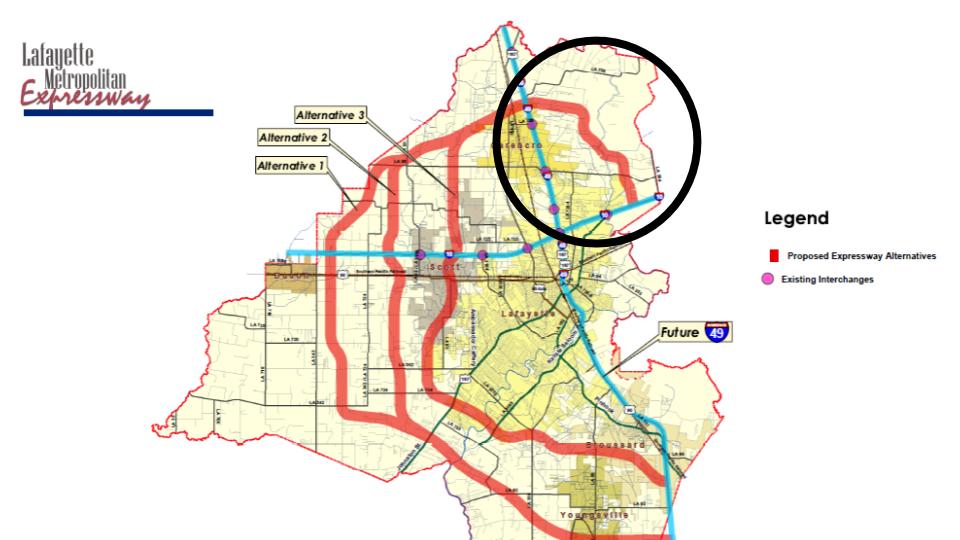


February 2005 “Study Corridor Map” from Figure 4-1 in the report “Lafayette Metropolitan Expressway, Technical Memorandum 4, Environmental Reconnaissance.” The black circle was added to the figure to indicate the segment termed the eastern corridor in these comments.


Michael G. Waldon, PhD
Resident of Lafayette Parish, Louisiana

March 15, 2019

Tuesday, February 26, 2019

Louisiana wants your opinion on a Lafayette Interstate 49 bypass, the LRX

Thursday, February 28, 2019, at the Lafayette Parish South Regional Library, the State of Louisiana will host a public hearing on their plans to build a western bypass around the City of Lafayette. The meeting will continue from 5:30 to until 7:30 pm.
Meeting Agenda:
  • 5:30-6:00 pm -View exhibits and speak with the project team
  • 6:00-6:15 pm - formal presentation
  • 6:45-7:30 - public invited to provide comments in a moderated and recorded forum
The host agency for the meeting is the Lafayette Metropolitan Expressway Commission or LMEC. Beginning almost twenty years ago, efforts and support of Lafayette civic leaders led to the creation of the LMEC by our Louisiana Legislature in 2003. The LMEC provides oversight for construction planning and financial planning for a proposed Lafayette limited access interstate bypass. They call their proposed bypass the LRX or Lafayette Regional Xpressway.
After years of work, plans have progressed, and the LMEC is seeking your comments on their Tier 1 Draft Environmental Impact Statement (EIS) which evaluates potential alternative highway corridors. The plan is for the LRX to be partially funded by tolls as part of a public-private partnership (PPP). As such, this project might be funded and built long before the costly I-49 connector (I-49 Con) project moves a shovel of dirt.  
The state will not say that the LRX is an alternative to the widely-opposed and costly I-49 Connector. I assume this is necessary to avoid loosing federal planning funds. However, the choice is clear - the LRX eliminates the reasons for building the I-49 Connector. If it is not an alternative then let's call it a substitute. If well managed and designed, the LRX substitute is financially a better deal for taxpayers. The LRX should have little or no flood impact, unlike the I-49 Con it will not cross a massive abandoned toxic site or impact our drinking water, and it will reduce traffic congestion in the city while giving rural residents new travel options. 
You can learn more about the LRX plan through the LMEC website http://www.lrxpressway.com/Their meeting announcement is available by clicking HERE.
DevelopingLafayette.com published an excellent article titled "Lafayette Metro Expressway “Lafayette Loop” Planning Continues.". And Claire Taylor published an article in The Advocate titled "Public can weigh in on Lafayette toll loop during Feb. 28 meeting." Click on the titles to read these articles.
Your comments to the LMEC and state DOTD will be accepted at the meeting. If you are unable to attend, or just want to give additional comments, you can submit your comments via their Web site (www.lrxpressway.com), or by U.S. mail to LRX Project Team, HNTB Corporation, 10000 Perkins Rowe, Ste. 640, Baton Rouge, LA 70810. Any written comments received by or postmarked on or before March 11, 2019 or 45 days following publication of the Notice of Availability in the Federal Register, whichever is later, will become a part of the record.
After the February 28 meeting I will publish an article here in Connector Comments detailing new LRX developments and comments I hear from other participants. 
I urge you to support the LRX and help save our city and parish from the disaster that is the I-49 Con.  
Alternative LRX corridor map from 2017 public meeting.

Wednesday, December 6, 2017

Public Comment to DOTD: Louisiana DOTD has failed both the letter and the spirit of our Open Meeting Law


Following below are the written comments that I submitted to DOTD after their October 19, 2017, "Open House" meeting at the Progressive Baptist Church in Lafayette. As I publish my written comments here, the meeting handout and DOTD's presentation materials are available online, but I do not believe any meeting speaker list, transcript of oral comments, or compilation of written comments has appeared on DOTD's official meeting site. It does appear that some of my comments have been deeply buried as deconstructed anonymous individual sentences in the View Public Comments page on the DOTD's Con web site. If you submitted comments, I welcome you to also add your comments here in the comments section at the end of this ConnectorComments.org post. And of course, all other relevant comments are also welcome here - I promise that I will not strip off your name and atomize your comments.


These comments are submitted in conjunction with the I-49 Lafayette Connector Open House held on Thursday, October 19, 2017, Lafayette, LA. I request that these comments be included in the official Public Meeting Transcript.


Louisiana DOTD has failed both the letter and the spirit of our Open Meeting Law


Since relaunching the I-49 Lafayette Connector project in October, 2015, open public comment has not been permitted at DOTD sponsored committee meetings. This action is in clear defiance of the spirit of open government. In the case of committee meetings which are convened to make recommendations or decisions, it is clearly illegal. In his defense, State Transportation Secretary Shawn Wilson has noted that the public is allowed one-on-one access to DOTD employees and contractors, and further, can provide written comments in a process similar to a collective project suggestion box. While both of these actions by the DOTD may be considered laudable, the fact remains that the public is not allowed public communication with committees which are assigned advisory and decision-making roles. The “Public Meeting” convened by DOTD on October 19, 2017 continues this policy of violation by segregating comments away from committees that make recommendations or decisions concerning this project.


Phase I reports are commonly prepared prior to land procurement by the government. These reports serve the purpose of finding potential liability for the state that is anticipated to occur if the state procures land that is contaminated. Normally, Phase I reports rely in-part on interviews with neighbors and others who may be knowledgeable of past land use and land contamination. However, the state’s contractor in this case was instructed to talk with no local people. The failure of the contractor to identify significant liabilities for the state and its taxpayers could be a direct result of this unusual decision to intentionally blind the investigators. For many months the citizens of our community have been requesting that the Connector project’s Draft Phase I Hazardous Waste study be made public, and that the public have an opportunity to comment on and suggest improvements in the plan. Why would the state NOT want to know more about liability from procuring contaminated land along the proposed I-49 right-of-way?


The “Community Working Group” committee met most recently on October 18, 2017. At this meeting, as all 14 prior meetings, the public was only allowed to observe; no time was allocated for the members of the public to directly address the CWG. At this meeting, Jan Grenfel (DOTD Environmental Compliance) stated that the Phase I Plan report will remain cloaked from public scrutiny and discussion. She said it will not be discussed, it will not be placed for public review on the  I-49 Connector web page http://lafayetteconnector.com/. Why would the DOTD intentionally hide from public view information on toxic contamination in our community? Why would DOTD wish to move forward with land procurement and construction without knowing all available information on risks to public health, and potential damage public land and private property?


What will it take to get our State Transportation Secretary, Dr. Shawn Wilson, to follow the Public Meeting law? If this behavior is allowed to set a precedent, all future public participation in Louisiana state and local government decision-making is in jeopardy. Both the Lafayette newspapers, the Independent and the Daily Advertiser, have editorials supporting the right of the public to speak at DOTD convened committee meetings. I sincerely ask that our Governor, John Bel Edwards, intercede to rein in the arrogance of government being followed by his transportation department.


Why is public's criticism so frightening to Dr. Wilson and the DOTD? Perhaps it is because
  • of the overwhelming public support for a bypass rather than an urban interstate through the historic heart of our city
  • of the DOTD's embarrassment at their failure to consider in all current and future planning any actual sampling or measurement of the toxics present in their proposed right-of-way
  • of lack of any assessment of the impact of driving pilings into our sole-source water supply through toxic wastes potentially destroying our Lafayette water supply with toxic contamination
  • of public health impacts from exposure to toxic construction-related dust containing asbestos, lead, and arsenic from decades of railyard activities
  • of noise impacts on home values
  • of noise and air pollutant impacts on our downtown parks and festivals
  • of air pollution from interstate traffic falling over our downtown and surrounding neighborhoods
  • of causing our city to fall into ozone non-compliance which could trigger annual auto tailpipe inspections and limits on future industrial expansion in the city
  • of adding risks of drowning for motorists forced to travel in a tunnel under the interstate near the airport and the Vermilion River
  • of flooding resulting from huge new paved impervious surfaces that are intended to drain to Bayou Vermilion with no attenuation
  • of hazardous cargo which would travel the elevated interstate at high speed over our houses
  • of the danger of falling objects limiting land use under the elevated interstate
  • of the hundreds of small businesses that will be harmed or destroyed without compensation
  • of the thousands of private property owners who will lose 10% to 15% of their home values because of interstate noise and proximity
  • of increased cross-city traffic on Pinhook, Johnston, University, and other streets that would be induced by this project (note that induced traffic demand has not been properly modeled)
  • of what else? What else would our citizens bring to the attention of planning committees if they were allowed to speak?
The EIS  performed by DOTD for this project nearly two decades ago was woefully inadequate and inaccurate when it was created. Further, it piecemealed impacts by breaking off the interstate construction south of the airport into a separate study. And, still worse, over the past decades this “Final” EIS has not aged gracefully. New scientific finding and changes in regulations make this document virtually irrelevant today.


Could these observations be the reason Shawn Wilson wants to stifle public input and awareness? Are there other reasons that Dr. Wilson no longer supports public openness and inclusion at DOTD?


Relevant Articles and Editorials


The Advertiser, April 29, 2016, Some not happy I-49 meetings don't allow public discussion


The Advertiser, May 5, 2016, Editorial: Let us reason together


The Advertiser, May 10, 2016, Voices: I-49 'public comment' requires large open forums


The Advertiser, May11, 2016, Schoeffler: I-49 connector meetings have violated Louisiana law


The Advertiser, May12, 2016, Voices: Consider all options when building I-49 connector


Published resources regarding Louisiana's Open Meeting Laws


The Louisiana Attorney General provides an overview and opinion on the application of Louisiana's Open Meeting Laws


Other sources of publicly available information include -


The Louisiana Open Meeting Law is available from LSU


and at this Louisiana Legislative Auditor site


The Public Affairs Research Council of Louisiana publishes a guide to Louisiana Open Meeting Laws


A document from 2009 on the Louisiana Culture Recreation and Tourism site describes 5 things you should know about Louisiana Open Meeting Laws  http://www.crt.state.la.us/Assets/OCD/hp/grants/certifiedlocalgovernment/documents-and-forms/Open_Meetings_Law.pdf


The Public Affairs Research Council in 2010 published this information on Louisiana's sunshine laws


Signed:
Michael G. Waldon, Ph.D.
110 Seville Blvd
Lafayette, LA 70503
email: mike@mwaldon.com


Please note: I request that my name remain with my comments, and that any publication of my comments by DOTD be posted complete and unedited.


Meeting Facility Map from DOTD Handout