This blog seeks to collect, archive, and make available public comments on the I-49 Lafayette Connector project which might otherwise be overlooked. The goal of this blog is to establish a dialog about the I-49 Connector project.
Note that this is NOT the site for official comment on the Lafayette Connector project.
site http://ConnectorComments.org email info@ConnectorComments.org
This work is licensed under a Creative Commons Attribution 4.0 International License.
How much can we trust the traffic model projections for Lafayette? Read this Journal of the American Planning Assoc. article which finds: "... forecasters generally do a poor job of estimating the demand for transportation infrastructure projects. ... For half of all road projects, the difference between actual and forecasted traffic is more than ±20%. The result is substantial financial risks, which are typically ignored or downplayed by planners and decision makers to the detriment of social and economic welfare." Flyvbjerg, B., M. K. Skamris Holm, et al. (2005). "How (In)Accurate Are Demand Forecasts in Public Works Projects? The Case of Transportation." Journal of the American Planning Association 71(2).
During presentations to the community, our Louisiana DOTD has given dire projections of traffic problems that they predict will happen in 2040 if we do not capitulate to building the I-49 Connector through the heart of Lafayette. As pointed out in the JAPA article, there is great uncertainty associated with all such predictions. And, beyond the model error discussed in this professional journal article, other uncertainties complicate the projections for Lafayette:
The model projections being presented to the community assume no tolls will be charged. Will the Connector charge tolls in 2040? We have been told on numerous occasions that tolls are likely the only feasible way to finance this project. Charging a toll will discourage use for local trips, and actually increase traffic on remaining surface city streets.
If the Connector is not built, what other highway improvements may happen prior to 2040? If the Connector concept is abandoned, it is likely that one of the proposed I-49 bypass routes will be developed. However, if the Connector is completed, it is unlikely Lafayette will see construction of a bypass by 2040.
What improvements in transportation technology will occur over the next 25 years? The model assumes that in 2040 we will still be driving the same basic cars and trucks, carrying the same freight loads on trucks, and using the same traffic management systems that are in use today.
What will Greater Lafayette's population be in 2040 and how will population centers change? The traffic model uses input demographic projections, and quality of the model output is no better than that of the input. We may believe that the trend of population growth south of Lafayette will continue unabated in future decades. However, realities of availability of suitably drained land, and future increases in flooding from the Vermilion and its tributaries may actually drive population growth north of the city. Really, only time will tell.
So, what does a wise investor do in the face of uncertainty? Certainly not construct the massively costly I-49 Lafayette Connector.
BOMBSHELL!!! Last night (April 28, 2016) following the Community Working Group meeting I learned from one-on-one discussion with Dr. Shawn Wilson, Secretary of Louisiana DOTD, that if the railroad is a willing seller of their abandoned rail yard then the current owner must clean it up or pay the state of Louisiana for the cleanup. HOWEVER, if the State expropriates the property, all cost of cleanup can fall to the taxpayer. This could relieve the responsible party of hundreds of millions in liability, and move it onto the public. A DOTD staff person confirmed this, and told me the state has already taken other contaminated property that is in I-49 Connector the right-of-way.
Now, if I were in the shoes of the railroad corporation or any of the other responsible parties who have cleanup liability, what would I do? It would certainly be in my self interest to just let the State of Louisiana take my land, pay me the estimated "fair market value," and enjoy total relief from all responsibility to clean up my own property and the property of property of my neighbors contaminated by migration of the waste. --Mike Waldon
This post is based on an earlier Facebook post available at https://www.facebook.com/photo.php?fbid=10204988937756624&set=a.1950146486814.85718.1637181971&type=3&theater
Incoming Louisiana Transportation Secretary Dr. Shawn Wilson assured
us that openness and inclusiveness will be important goals of DOTD
under his leadership (fast forward to time 6 minutes 12 seconds).
Since relaunching the I-49 Lafayette Connector project in October, open public comment has not been permitted at DOTD sponsored meetings. This action is in clear defiance of the spirit of open government. In the case of committee meetings which are convened to make recommendations or decisions, it is clearly illegal. In his defense, State Transportation Secretary Shawn Wilson has noted that the public is allowed one-on-one access to DOTD employees and contractors, and further, can provide written comments in a process similar to a collective project suggestion box. While both of these actions by the DOTD may be considered laudable, the fact remains that the public is not allowed public communication with committees which are assigned advisory and decision-making roles.
What will it take to get our State Transportation Secretary to follow the law? If this behavior is allowed to set a precedent, all future public participation in Louisiana state and local government decision-making is in jeopardy.
Why is the public's criticism so frightening to Dr. Wilson? Perhaps it is because
of the overwhelming public support for a bypass rather than an urban interstate
of the DOTD's embarrassment at their failure to consider in all current and future planning any actual sampling or measurement of the toxics present in their proposed right-of-way
of lack of any assement of the impact of driving pilings into our sole-source water supply through toxic wastes potentially destroying our water supply with toxic contamination
public health impacts from exposure to toxic construction-related dust containing asbestos, lead, and arsenic from decades of rail yard activities
of noise impacts on home values and use of outdoor spaces downtown,
of noise and air pollutant impacts on downtown festivals
of air pollution from interstate traffic falling over our downtown and surrounding neighborhoods
of causing our city to fall into ozone non-compliance which could trigger annual auto tailpipe inspections and limits on future industrial expansion in the city
of adding risks to air travelers as their airplanes must liftoff and land over the elevated interstate proposed to be constructed at the end of the Lafayette Airport runway,
of flooding resulting from huge new paved impervious surfaces that are intended to drain to Bayou Vermilion with no attenuation,
of flooding and wetland loss caused by filling acres of wetland in order to extend the airport runway
of what else?
The EIS performed by DOTD for this project was woefully inadequate and inaccurate when it was created. Further, it piecemealed impacts by breaking off the airport reconstruction into a separate study. And, still worse, over the past 15 years that EIS has not aged gracefully. New scientific finding and changes in regulations make this document virtually irrelevant today.
Could these observations be the reason Shawn Wilson wants to stifle public input and awareness? Are there other reasons that Dr. Wilson no longer supports public openness and inclusiveness at DOTD?
This graph displays velocity of water flow in the Vermilion at the Surrey Street Bridge. A large rain storm occurred on April 30-May 1. Negative velocity shown in the graph indicates that the Vermilion was flowing upstream in response to the storm.
Lafayette Parish flooding will be increased along the Vermilion River and its tributaries by the Connector project.
A big rainstorm occurred in Lafayette beginning April 30, 2016. Look at this graph of Bayou Vermilion water velocity at Surrey Street - the negative velocity (up to 2 feet per second) means the Bayou is flowing backwards fast! This has important implications for flood control and planning in our community. Much of our flooding happens from water stacking up in the Bayou with no way to flow south. Drainage "improvements" bringing higher peak flows into the Bayou south of the city can raise the stage so much that this downstream water actually flows north and creates a "water dam." Now, coulees draining the storm water from city neighborhoods must either fill the Bayou to higher levels (stages), or back up with no outlet. Many flood planning computer models ignore this "backwater effect." That's OK in most other places in the US, but literally disastrous for flood planning in South Louisiana.
Video: Backwater in Coulee Mine Branch, Lafayette, La.
NOW - What action do you need to take? When planners for new projects say they have done careful computer analysis and determined that no new flooding will result from their project be very skeptical. Ask if they took backwater flooding into account for both their project near and upstream of their project. You will likely be met with ignorance, arrogance, and condescension, but do persevere. What projects? Well the I-49 Connector comes to mind. AND - What analysis of flooding impacts did DOTD provide in their 2002 EIS for the I-49 Connector? Basically nothing. Their plan is to provide the very efficient drainage required by interstates, and route the water to the Vermilion either directly, through existing drainage structures, or using very large pumps. No accounting for flood impacts from this massive increase in impervious surface is even attempted. No proposals have been made to build stormwater retention/detention basins for the project. In the EIS, no consideration was given to the residential and street flooding that will result from the project. It is likely we will experience heavy rain during hurricane evacuation, and this planning deficiency is all the more alarming when hurricane evacuation is considered. There is a history of DOTD flood and drainage design along US-90 and I-49. During a heavy rain event in 2001, cars went underwater on Hwy 90 east of Broussard where Hwy 92 crosses US-90. Cars had to be routed over to the Teche Ridge area on Hwy 31. In the April 30 - May 1 rain storm The Advertiser (1) reported rainfall of over 10 inches. While this is large, Louisiana at times receives over 20 inches of rain in a day. Occurrence of flooding of the I-49 roadway just north of Lafayette is an alarming sign that the I-49 corridor is not well designed for hurricane or flood evacuation.
Photo: The Advertiser (1).
Further, some DOTD plans for the I-49 Connector call for excavating underpasses or even depressing large parts of the interstate roadway itself. As local citizens know all-too-well, below grade underpasses in South Louisiana have a problematic history (2). Reliance on large pumps makes travel during heavy rain events reliant on maintaining electric power at the pump stations (assuming electric pumps are used), or reliability of diesel-driven pumps and fuel delivery (if diesel power is selected). 1. The Advertiser, May 2, 2016, Flooding Sunday some of the worst seen in years http://www.theadvertiser.com/story/weather/2016/05/01/-49-close-due-flash-flooding/83787580/
2. KLFY, March 18, 2016, University Ave underpass near Cameron St OPEN after flooding http://klfy.com/2016/03/18/university-ave-underpass-near-cameron-st-open-after-flooding/
These findings bring starkly into question the Lafayette Connector Conceptual Design as displayed in their cover photo (above). Promoting pedestrian use, concerts, parks, playgrounds, and other recreational uses under and surrounding the elevated interstate is ill-advised if such activities may increase health risks. Indeed, the social justice of new urban interstate construction is questionable when findings show that residents living near interstates suffer health risks not shared by the rest of the community. Future use of downtown venues for public festivals and concerts will be jeopardized by the Connector.
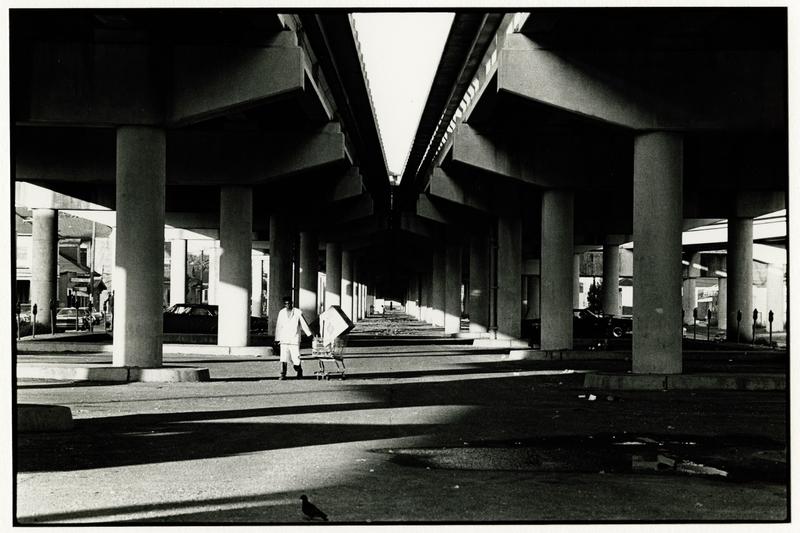
George Santayana is credited with saying "Those who cannot remember the past are condemned to repeat it." With that in mind, look at the history of destruction left by the Louisiana DOTD as they developed urban interstates in the 1960's. In New Orleans they proposed the Riverfront Expressway through the French Quarter and along the Mississippi River. Thankfully, the public outcry prevailed to stop the French Quarter section of interstate, but the Expressway was built through the Treme neighborhood over Claiborne Avenue in 1968.
Plans for the Lafayette Connector date back to this era of urban destruction and social injustice. How can DOTD prevent the same destruction and injustice in Lafayette today that they brought about nearly 50 years ago in New Orleans?
As just one example, the Victory Garden on S. Pierce Street
will be in danger of contamination from construction dust
containing lead, arsenic, asbestos, and other toxics (photo by
M. Waldon, no rights reserved).
Abandoned rail yards are typically found to have very high levels of contamination from numerous toxic materials. Among these are lead (paint and batteries), arsenic (widely used by railroads for pest control, weed control, and as a wood preservative in rail ties), and asbestos (steam engine firebox and boiler). It is believed that very high levels of these substances contaminate the soil in the abandoned rail yard and along the rail line within the I-49 Connector area. Any construction involving vehicular traffic driving across this soil, and any soil excavation will result in liberation of these toxics as dust.
How will toxic dust be monitored within and at the fence line of the Connector project?
How will the workers on-site be protected? Will all workers be required to wear respirators or other protective devices during construction?
How will the public, particularly neighborhood children, be protected from this hazardous toxic dust?
The Feen N Seed at 106 N. Grant Street has marked for removal by the Louisiana DOTD. Photo - M Waldon, no rights reserved.
How can the DOTD mitigate the cultural loss to our community as they destroy the Feed N Seed (http://feednseedlafayette.com/) and other historic and cultural sites in our city? This venue provides the community with diverse offerings such as the performance and release party described in an article in The Advocate titled "Mike Dean to release new live album at Feed N Seed in Lafayette."
Most dramatic are the conversions of a street in Minneapolis, and the covering of the open-air recessed freeway in Dallas. All of which beg: if Lafayette, LA wants to spend $700 million to $1 billion on a 5 mile freeway connector, what other potentialities for urban space, that creates value for human beings on the ground, in private and public spaces are possible?#Y49Lafayette indeed.#LafayetteConnector
What other possibilities for use of this space were considered instead of the urban freeway planned in this project?
This Facebook post generated interesting dialog through comments. I request that DOTD provide a response to this post and its associated comments.